
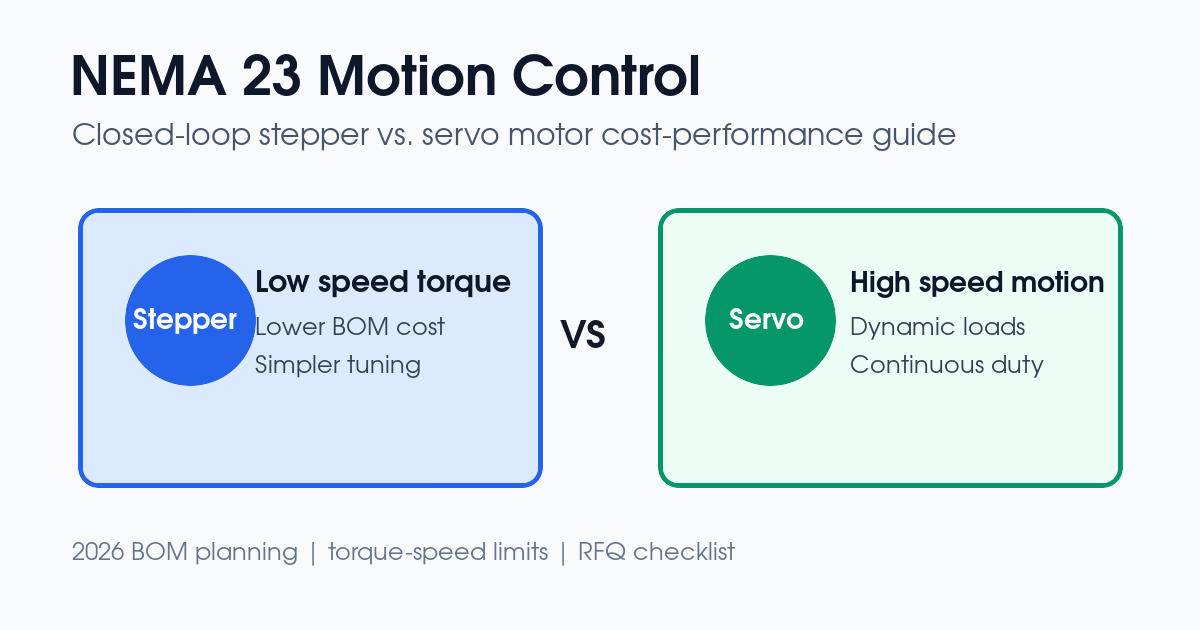
High-Torque Density NEMA 23 Steppers: Engineering Benefits and Procurement ROI for 2026
2026 NEMA 23 stepper motor guide for high-torque sourcing: compare torque density, BOM trade-offs, driver limits, RFQ checks, and procurement ROI.
For decades, engineers and procurement teams faced a rigid ceiling when designing small-form-factor automation: once a standard NEMA 23 stepper motor maxed out its torque curve around 1.8 to 2.2 Nm (250-310 oz-in), the only options were to add an expensive planetary gearbox or upgrade to a significantly bulkier NEMA 34 frame.
In 2026, advances in stator winding density, tighter air gaps, and high-grade neodymium magnetic materials have redefined these boundaries. High-torque density NEMA 23 stepper motors can now push beyond 3.0 Nm (425 oz-in) of holding torque within the same 57mm x 57mm faceplate footprint.
For machinery OEMs, medical device builders, and robotics integrators, this is more than an engineering upgrade: it can reduce Bill of Materials (BOM) line items, simplify supply chains, and reduce machine weight when the torque-speed curve still fits the axis duty point.
Last updated: 2026-07-20.
Scope: Procurement cost-benefit analysis, technical boundaries, and vendor evaluation for high-torque NEMA 23 applications.
Method note: The cost ranges below are RFQ-screening bands for global buyers, not guaranteed catalog pricing. Validate final quotes against supplier torque-speed curves, bus voltage, phase current, duty cycle, certification needs, and sample-axis thermal tests.
Fast path for active RFQs: Start with the NEMA 23 stepper motor selection guide, confirm NEMA 23 dimensions, match the NEMA 23 stepper driver, then contact our engineering team if you need a torque-curve or BOM review before purchase order release.
1. The Economics of Torque Density
When analyzing landed costs in 2026—factoring in volatile shipping rates and regional tariffs—downsizing components is one of the most effective cost-mitigation strategies.
By utilizing a high-torque NEMA 23 motor instead of a legacy solution, you can often remove mechanical speed reducers entirely. Direct-drive configurations reduce assembly time, eliminate backlash introduced by gear teeth, and remove a potential point of failure from the maintenance schedule.
Cost and Footprint Comparison Table
| Metric / Configuration | Legacy NEMA 23 (2.0 Nm) | High-Torque NEMA 23 (3.0 Nm) | Legacy NEMA 34 (3.5 Nm) | 2026 Procurement Impact |
|---|---|---|---|---|
| Screening Motor Cost | Baseline ($25 - $40) | Slight Premium ($35 - $60) | High ($70 - $120) | Can avoid the NEMA 34 premium when the duty point fits |
| Frame Size (Faceplate) | 57mm x 57mm | 57mm x 57mm | 86mm x 86mm | Massive space savings in compact OEM machines |
| Rotor Inertia | Low (approx. 480 g·cm²) | Moderate (approx. 800 g·cm²) | High (approx. 1400 g·cm²) | Better dynamic response than NEMA 34 |
| Gearbox Requirement | Required for > 2.0 Nm | Not required for up to 3.0 Nm | Not required | Can remove a separate gearbox line item where holding torque is enough |
| Drive Amp Requirement | Standard (2.5A - 4.0A) | High (4.0A - 6.0A) | Very High (5.0A - 8.0A) | May require a slightly upgraded NEMA 23 stepper drive |
| Shipping Weight (Est.) | 1.0 kg | 1.3 kg | 2.5+ kg | Lowers inbound freight exposure versus a NEMA 34 frame |
2. Visualizing the BOM Consolidation
The shift to a high-torque direct-drive setup fundamentally changes the mechanical assembly of an axis.
Space and Cost Savings: Geared vs. Direct Drive
3. Engineering & Sourcing Qualification Checklist
Before upgrading a BOM to include high-torque NEMA 23 motors, engineering and procurement teams must align on the system-level impacts. Use this checklist to validate your vendor and application:
- Drive Capability: Does our existing stepper driver support the higher phase current (often 4.0A to 6.0A) required by the new motor without overheating?
- Inductance Check: Is the motor's phase inductance low enough to maintain torque at our target operating RPM, or will back-EMF cause premature stalling?
- Thermal Dissipation: Is the mounting bracket capable of acting as an adequate heatsink for a motor generating higher magnetic flux and heat?
- Shaft Strength: Given the increased torque output (up to 3.0 Nm), does the supplier offer an upgraded 8mm or 10mm shaft diameter to prevent shearing under heavy radial loads?
- Supplier Consistency: Can the manufacturer guarantee consistent magnetic material sourcing (e.g., N35SH or higher grade magnets) across batch orders to avoid torque drop-offs in production?
4. Frequently Asked Questions (FAQ)
Q: Will a high-torque NEMA 23 fit in my existing NEMA 23 mounting bracket? A: Yes, the faceplate dimensions (57mm x 57mm) and the four-hole mounting pattern (47.14mm spacing) are standard. However, the body length is typically longer (often 100mm to 112mm). You must verify rear clearance in your machine chassis.
Q: Can I run a 3.0 Nm high-torque stepper at high speeds? A: High holding torque usually comes at the expense of high-speed performance due to higher coil inductance. If your application requires high torque at speeds above 800 RPM, you may need a higher voltage power supply (e.g., 48V or 72V) to push current through the coils fast enough, or you might need a closed-loop system.
Q: Are there supply chain risks with the high-grade magnets used in these motors? A: High-torque motors rely on strong rare-earth magnets. In 2026, geopolitical shifts can impact rare-earth pricing. We recommend partnering with suppliers who practice active multi-sourcing for raw materials to insulate your pricing from sudden shocks.
5. Next Steps for Procurement & Engineering
Upgrading to high-torque NEMA 23 stepper motors provides a rare opportunity to improve machine performance while simultaneously driving down BOM costs.
To ensure the new motor's torque curve aligns with your specific load and speed requirements, it is critical to evaluate the motor and driver as a matched pair.
Ready to optimize your axis design? Use the NEMA 23 stepper motor selection guide to shortlist high-torque options, then review compatible NEMA 23 stepper drivers before changing the BOM. If you are preparing a 2026 RFQ and want to ensure you are getting the best cost-to-performance ratio, contact our engineering team for a free BOM review and torque-curve analysis.
Sources
Next step for your project
Share torque, speed, driver requirements and planned volume for an OEM inquiry review.