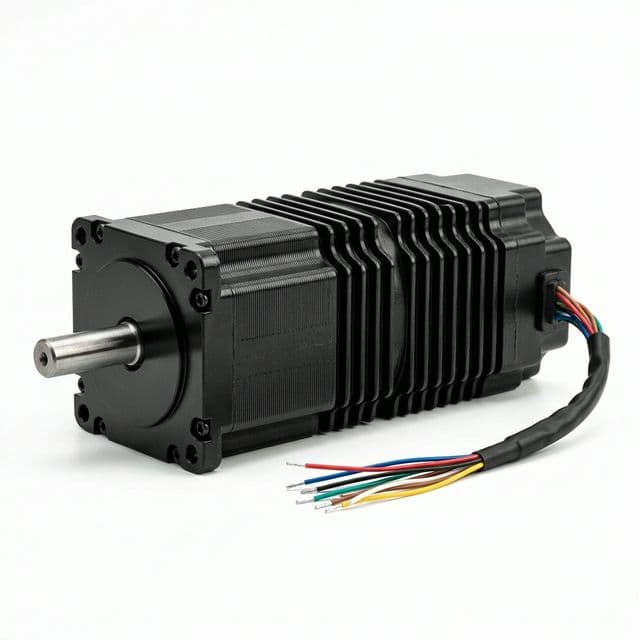
280 oz-in NEMA 23 Tool and 24.0 kg-cm Decision Report
This guide covers both high torque stepper motor and the 12v stepper motor high torque alias, the 12v stepper motor high torque 5000 rpm query, plus the 12v high torque stepper motor scenario, including the 12v dc stepper motor high torque arms variant, the 280 oz-in nema 23 stepper motors alias, and the 24.0 kg-cm 333.2 oz-in 4 wire nema 23 stepping motor alias phrase. Use the tool first to check electrical feasibility, then use report layers to decide what to buy, what to test, and where risk sits.
Tool Layer: 12V Fit Checker and Resolution Index
Enter your setup. This tool unifies the electrical fit check for high torque NEMA 23 motors and the microstep resolution calculator with incremental torque attenuation.
Result Layer: Interpretation + Action
Results are grouped by summary, electrical model and thermal impact. Use the mode toggle to reveal details progressively without losing the top-line decision.
Alias Summary: 280 oz-in NEMA 23 and 24.0 kg-cm 4-Wire
This layer explains "280 oz-in nema 23 stepper motors" and the 24.0 kg-cm alias operationally: normalize torque first, then evaluate electrical and motion feasibility from the real winding data.
Exact search treated as a NEMA 23 high-torque alias
20.2 kg-cm using traceable conversion factors.
Search phrase declared nameplate torque
"333.2 oz-in" is a rounded query value (delta 0.1 oz-in).
Use SI as base unit for load and acceleration calculations.
| Query | Normalized Torque | Interpretation | What to Validate | Evidence |
|---|---|---|---|---|
| 280 oz-in NEMA 23 stepper motors resolution | Angular: 1.8°/0.9° per step, Microstep: 0.1125° @ 1/16 | The resolution (positional step increments) of a 280 oz-in NEMA 23 motor. It depends on step angle and microstepping, but incremental torque decays at high microsteps. | Calculate theoretical resolution using the tool, then check incremental microstep torque against friction to verify loaded accuracy. | E18, E42, E43 |
| 280 oz-in NEMA 23 stepper motors | 1.98 N·m / 20.2 kg-cm | A mid-high NEMA 23 holding-torque class near 2.0 N·m. It is close to catalog examples around 283.22 oz-in, but still must be treated as holding torque until speed-torque data is confirmed. | Run the tool with the candidate motor R/L/current, then verify driver voltage, pulse budget, and loaded speed-torque margin before RFQ release. | E18, E40, E41 |
| 283.22 oz-in / 2.0 N·m catalog class | 2.00 N·m / 283.22 oz-in | A supplier-visible NEMA 23 example near the 280 oz-in search phrase, useful as a sanity check but not a universal specification. | Confirm the exact datasheet revision, phase current, resistance, inductance, shaft, lead count, and driver voltage class. | E40 |
| 24.0 kg-cm / 333.2 oz-in 4-wire NEMA 23 | 2.35 N·m / 333.3 oz-in | A higher holding-torque alias already covered by the page. The 4-wire note means bipolar-fixed wiring, so there is no 6/8-lead series/parallel rescue path. | Treat wiring as fixed, reject rewiring assumptions, and validate voltage/current/pulse boundaries directly. | E18, E37, E39 |
| 28byj-48 stepper motor higher torque | ~0.03 N·m (28BYJ-48) vs >1.0 N·m (NEMA 23) | The 28BYJ-48 is a 5V geared micro-stepper. "Higher torque" searches indicate an intent to upgrade to an industrial frame like NEMA 23. | Transitioning to NEMA 23 requires moving from ULN2003 boards to constant-current chopper drives (e.g., DM542E) and higher voltage (12V-48V). Use the tool to size the new driver and bus. | E44 |
| Source Case | Torque Class | Electrical Package | Boundary / Condition | Decision Use | Evidence |
|---|---|---|---|---|---|
| Exact 280 oz-in search phrase | 1.98 N·m / 20.2 kg-cm | No single public package; the phrase states holding torque class, not phase current, R, L, shaft, encoder, or driver. | Pending confirmation until the candidate datasheet and speed-torque curve are named. | Use only as a normalized RFQ starting point, then require winding data before approval. | E18, E40, E41 |
| StepperOnline 23HE30-2804S open-loop example | 2.0 N·m / 283.22 oz-in | 4-wire, 1.8°, 2.8A/phase, 1.17Ω resistance, 4.8mH inductance, Class B insulation. | Useful near-280 oz-in comparator, but not proof that every 280 oz-in motor shares this winding. | Run the checker with 2.8A, 1.17Ω, 4.8mH and validate current rise at target RPM. | E40 |
| StepperOnline 23HS30-5004D-E1000 closed-loop kit example | 2.0 N·m / 283.22 oz-in | Closed-loop NEMA 23 kit motor, 5.0A/phase, 0.42Ω resistance, 1.7mH inductance, encoder package. | Same holding-torque class can imply much higher current and lower inductance, plus driver/encoder integration. | Do not substitute against open-loop 2.8A motors without changing current, cable, driver, and fault-handling assumptions. | E41 |
| 28BYJ-48 to NEMA 23 Upgrade | 0.03 N·m -> >1.0 N·m | Replaces 5V unipolar (ULN2003) with 12V-48V bipolar (A4988/DM542E). | Requires a complete redesign of the electrical drive tier; a simple drop-in replacement is impossible. | Use the checker to size the new NEMA 23 electrical requirements (voltage, current, RL) and pulse limits. | E44 |
| Universal loaded RPM / accuracy claim | Unavailable as a public one-number limit | Depends on motor winding, driver bus, controller pulse ceiling, load inertia, acceleration, thermal enclosure, and speed-torque curve. | No reliable public dataset found for universal loaded RPM or loaded accuracy of all 280 oz-in NEMA 23 motors. | Keep final result pending until selected motor-driver pair is tested on the real axis. | E5, E13, E23 |
| Profile | Fit When | Not Fit When | Minimum Action | Evidence |
|---|---|---|---|---|
| Procurement with a fixed 4-wire NEMA 23 candidate | Needs to normalize 24.0 kg-cm into oz-in/N·m before RFQ or supplier-sheet comparison. | Treats nameplate torque as guaranteed output at 5000RPM. | Normalize units, run the checker with real R/L/current values, and attach fit/watch/limit evidence to RFQ. | E18, E30 |
| Controls team targeting high-speed motion | Needs voltage-headroom and STEP-demand validation after alias normalization. | Controller pulse ceiling is below demanded pulse rate. | Verify controller STEP ceiling and rerun with 24V/48V baseline scenarios. | E3, E31, E32 |
| Mechanical arm or rotary-axis team | Wants to convert nameplate torque into a static gate before adding inertia and acceleration terms. | BOM is frozen without tau_total validation against speed-torque curves. | Apply tau_static + tau_accel screening and validate under loaded ramps before procurement. | E13, E19, E20, E21 |
Report Layer: Microstepping Resolution vs. Open-Loop Accuracy
For a 280 oz-in (2.0 N·m) high-torque NEMA 23 motor, engineers often confuse "commanded microstep resolution" with "actual positioning accuracy". This section details the physical limitations under mechanical system friction.
| Microstep Ratio | Angular Resolution | Incremental Torque (oz-in) | Incremental Torque (N·m) | % of Holding Torque | Absolute Accuracy Risk |
|---|---|---|---|---|---|
| 1/1 (Full Step) | 1.8000° | 280.00 | 1.977 | 100% | None. Maximum torque stiffness. |
| 1/2 (Half Step) | 0.9000° | 197.99 | 1.398 | 70.7% | Very low. Excellent for power positioning. |
| 1/4 (Quarter) | 0.4500° | 107.16 | 0.757 | 38.3% | Low. Superb torque-to-smoothness balance. |
| 1/8 (Eighth) | 0.2250° | 54.62 | 0.386 | 19.5% | Low-Medium. Recommended standard lead-screw resolution. |
| 1/16 (Sixteenth) | 0.1125° | 27.44 | 0.194 | 9.8% | Medium. Practical limit for open-loop accuracy. Standard friction can cause 1-2 step lags. |
| 1/32 | 0.05625° | 13.73 | 0.097 | 4.9% | High. Incremental step torque is lower than friction on typical CNC axes. |
| 1/64 | 0.028125° | 6.87 | 0.049 | 2.5% | Critical. Rotor remains stationary until multiple pulses build enough torque. |
| 1/128 | 0.01406° | 3.44 | 0.024 | 1.2% | Useless for accuracy. Purely serves to reduce acoustic noise. |
| 1/256 | 0.00703° | 1.72 | 0.012 | 0.6% | Useless for accuracy. Minor friction completely absorbs microstep resolution. |
1. Ballscrews (SFU1605/1610): In open-loop configurations, pair with 1/8 or 1/16 microstepping. This yields a theoretical step resolution of 2.5 μm or 1.25 μm with SFU1605, matching standard mechanical load stiffness limits. Higher microstep settings only dissipate heat without improving positional tolerance.
2. Belt & Pulley (GT2 2mm, 20T): One rev translates to 40mm linear travel. At 1/16, step size is 12.5 μm. Due to belt elasticity, microsteps finer than 1/8 suffer from compliance windup; use geared reductions or closed-loop feedback if dynamic stopping accuracy under load is required.
Current Shaping: Ensure the driver is fed with ample voltage (minimum 24V, ideally 48V for 280 oz-in class) to allow current to rise rapidly in the phase inductor, preventing torque collapse from corrupting the microstep shape.
Closed-Loop Encoder Feedback: Closed-loop NEMA 23 kits with 1000-line optical encoders monitor rotor lag in real-time. If friction blocks a microstep, the controller spikes phase current (up to overload limits) to force the rotor to its target position, recovering true microstep precision.
Validation Gap Review and Closure
This enhancement round focuses on information gain, evidence quality, and decision safety. Gaps are tracked explicitly so unresolved items stay visible as pending, not hidden by generic wording.
| Gap | Why It Mattered | Applied Update | Status |
|---|---|---|---|
| Core conclusions lacked explicit source linkage. | Users could read conclusions but needed extra effort to verify evidence lineage for each claim. | Added evidence IDs to conclusions and added a dedicated conclusion-to-evidence traceability table. | Closed |
| 12V counterexamples were implied, not structured. | Without structured counterexamples, teams could over-generalize one successful bench case. | Added a scenario-grade counterexample matrix for 12V viability, driver minimum voltage, and pull-out torque boundaries. | Closed |
| High-impact electrical risks were under-specified. | Bus spikes and deceleration back-EMF can damage hardware even when average current appears acceptable. | Added explicit LC-spike and deceleration back-EMF risk controls with source-backed mitigation actions. | Closed |
| Pulse timing limits were not explicit in the decision path. | Teams could pass frequency checks but still violate STEP high/low or DIR setup requirements at integration time. | Added a driver timing constraint table (A4988/DRV8825/DM542E class) and linked it to risk and FAQ actions. | Closed |
| Arm-load torque translation was missing from the tool-to-report bridge. | Users searching for high-torque arm decisions need mass/radius torque framing, not only electrical metrics. | Added static arm-torque scenarios with SI and oz-in conversion, plus explicit dynamic torque boundary (tau = I x alpha). | Closed |
| Load-inertia and resonance limits were still mostly qualitative. | Without numeric gates, teams could skip critical startup/ramp checks and misinterpret short bench passes as production-safe. | Added a motion guardrail table with quantified utilization, inertia-ratio, resonance, and no-load-accuracy boundaries tied to minimum executable actions. | Closed |
| 6/8-lead wiring topology tradeoffs were not decision-visible. | Users evaluating 12V paths need to understand how rewiring changes R/L/current demand before locking driver class. | Added a wiring tradeoff matrix (unipolar vs bipolar-series vs bipolar-parallel) with explicit multipliers and applicability limits. | Closed |
| Cable and harness integration boundaries were under-specified. | Real failures often appear after harness scaling, even when short-bench setups looked stable. | Added integration constraints table for cable length, conductor gauge, and insulation-class interpretation with concrete verification actions. | Closed |
| 5000RPM pulse-demand feasibility was not explicit by microstep and driver class. | Teams could assume high microstep settings were always feasible, then discover controller/driver pulse ceilings late in commissioning. | Added a 5000RPM pulse-feasibility matrix mapping microstep demand to A4988/DRV8825/DM542E-class STEP-input limits with minimum actions. | Closed |
| Controller-side pulse ceiling lacked a concrete, source-backed benchmark. | Users could read driver input limits, but still miss controller bottlenecks that make 5000RPM targets infeasible in practice. | Added a controller pulse-ceiling reality table using Grbl 1.1 ATmega328P 30kHz reference and converted it into max-RPM gates by microstep. | Closed |
| Carrier-board thermal current envelope was blurred with chip-level datasheet limits. | Teams could over-trust 2A-class chip ratings and under-budget cooling on A4988/DRV8825 module builds. | Added a carrier thermal-envelope table with no-heatsink vs cooled current ranges (A4988/DRV8825 classes) and explicit limit notes. | Closed |
| NEMA frame-size interpretation boundary was still implicit. | Users can over-read "NEMA 23" as a torque/speed promise instead of a geometry definition, causing early BOM misalignment. | Added concept-boundary table clarifying frame-size scope versus electrical-performance scope and linked it to sizing actions. | Closed |
| Back-EMF and over-voltage thresholds lacked hard numeric guardrails. | Without numeric voltage-protection boundaries, deceleration events can create avoidable field failures. | Added source-backed limits for deceleration/back-EMF and driver over-voltage boundary (DM542E >60V protection trigger context). | Closed |
| Current-overdrive and microstep torque-penalty boundaries were under-emphasized. | Teams might chase torque by overcurrent or microstep inflation without quantifying demagnetization and torque-loss risk. | Added explicit boundary notes from official motor-basics guidance covering overcurrent saturation risk and microstep torque caveats. | Closed |
| Alias intent "24.0 kg-cm 333.2 oz-in 4 wire nema 23 stepping motor" lacked a direct tool-facing bridge. | Users could find the canonical page but still miss immediate conversion context and 4-wire applicability boundaries at first screen. | Added alias quick-decode cards, torque normalization method rows, and explicit 4-wire fit/not-fit guidance linked to evidence and CTA. | Closed |
| Alias intent "280 oz-in nema 23 stepper motors" was not explicitly connected to the canonical high-torque tool. | Users searching by the 280 oz-in class needed immediate unit normalization and a warning that nearby catalog motors can have different winding data. | Added 280 oz-in conversion cards, a torque-alias comparison table, supplier evidence rows, and FAQ guidance that routes the alias into the same fit checker. | Closed |
| 280 oz-in evidence was still too compressed for supplier substitution decisions. | A buyer could normalize torque correctly but still miss that near-283 oz-in public examples differ sharply in current, resistance, inductance, and closed-loop integration. | Added a dedicated 280 oz-in evidence matrix with open-loop and closed-loop public examples, explicit pending-confirmation status, and minimum actions for RFQ validation. | Closed |
| 4-wire applicability boundaries still lacked wiring-manual-grade closure. | Teams could assume 4-wire motors support the same rewiring levers as 6/8-wire motors and freeze a risky current plan. | Added a dedicated 4-wire/0.9° boundary table with manual-backed current-setting rules and explicit no-rewire constraints. | Closed |
| Step-angle sensitivity (1.8° vs 0.9°) was not quantified in the 5000RPM pulse path. | Assuming 200 full-steps/rev for all motors can under-estimate pulse demand by 2x and hide infeasible controller/driver combinations. | Added a step-angle pulse-stress table showing 1.8° and 0.9° cases at 5000RPM (8x/16x) against DM542E and A4988 pulse ceilings. | Closed |
| DM542E source-revision drift was not explicitly surfaced. | Vendor product pages and manual tables list different microstep ranges; using mixed revisions can invalidate speed assumptions. | Added a source-drift register and a minimum-action rule to freeze the exact driver revision and DIP table before BOM release. | Closed |
| Universal RPM and enclosure thermal outcomes remained uncertain. | No reliable public dataset covers all NEMA 23 variants, inertias, and enclosure geometries. | Kept this as an explicit uncertainty and marked as pending confirmation to prevent fabricated one-number claims. | Open (pending confirmation) |
| Microstep | Steps/rev | Required Pulse (kHz) | DM542E (200kHz) | DRV8825 (250kHz) | A4988 (500kHz) | Note | Evidence |
|---|---|---|---|---|---|---|---|
| 1x | 200 | 16.7 | Fit | Fit | Fit | Pulse requirement is within common driver STEP-input ceilings; still validate controller output and signal integrity. | E16, E17, E28 |
| 2x | 400 | 33.3 | Fit | Fit | Fit | Pulse requirement is within common driver STEP-input ceilings; still validate controller output and signal integrity. | E16, E17, E28 |
| 4x | 800 | 66.7 | Fit | Fit | Fit | Pulse requirement is within common driver STEP-input ceilings; still validate controller output and signal integrity. | E16, E17, E28 |
| 8x | 1600 | 133.3 | Fit | Fit | Fit | Pulse requirement is within common driver STEP-input ceilings; still validate controller output and signal integrity. | E16, E17, E28 |
| 16x | 3200 | 266.7 | Limit | Limit | Fit | At 5000RPM, this microstep level exceeds common DM542E/DRV8825 pulse ceilings. | E16, E17, E28 |
| 32x | 6400 | 533.3 | Limit | Limit | Limit | At 5000RPM, this microstep level exceeds common DM542E/DRV8825 pulse ceilings. | E16, E17, E28 |
| Controller / Stack | Published Pulse Ceiling | Max RPM @8x | Max RPM @16x | 5000RPM @16x Feasibility | Evidence | Note |
|---|---|---|---|---|---|---|
| Grbl 1.1 (ATmega328P class: Uno/Nano) | 30.0kHz | 1125.0 | 562.5 | Limit | E31, E32 | At 16x and 5000RPM, required pulse is 266.7kHz (~8.9x above 30kHz ceiling). |
| Project final controller (not declared) | Pending | Pending | Pending | Pending confirmation | N/A | Without declared controller/firmware/signal chain, target-RPM closure remains uncertain. |
| Step angle | Full steps/rev | Pulse @8x | Pulse @16x | DM542E @8x | DM542E @16x | A4988 @8x | A4988 @16x | Note | Evidence |
|---|---|---|---|---|---|---|---|---|---|
| 1.8° | 200 | 133.3kHz | 266.7kHz | Fit | Limit | Fit | Fit | 1.8° baseline used by common microstep tables. | E36, E37 |
| 0.9° | 400 | 266.7kHz | 533.3kHz | Limit | Limit | Fit | Limit | 0.9° doubles pulse demand versus a 1.8° assumption. | E36, E37 |
| Parameter | Source A | Source B | Decision Impact | Minimum Action | Evidence |
|---|---|---|---|---|---|
| Microstep resolution list | Leadshine product page: 200 to 51,200 steps/rev (DIP) | DM542E user-manual table: 400 to 25,600 steps/rev for 1.8° motors | Selecting DIP values from the wrong document revision can under-estimate pulse demand by 2x and invalidate 5000RPM assumptions. | Freeze the exact driver revision + DIP table in BOM, then recompute RPM ceiling from that table before commissioning. | E36, E37 |
| Current setting rule after rewiring | DM542E user manual (6-lead full-coil): start near 70% of rated current | DM542E user manual (8-lead parallel): set current to about 1.96x unipolar or 1.4x bipolar-series current | Applying series-current settings to parallel wiring (or vice versa) can overheat the motor or erase expected torque gains. | Treat each wiring topology as a new current-setting problem and rerun thermal validation before release. | E37 |
| Carrier | Approx. No-Heatsink Current | Current with Added Cooling | Voltage Window | Risk Read | Evidence |
|---|---|---|---|---|---|
| A4988 carrier (green, 2-layer) | ~1.0A/phase | Up to ~2.0A/coil | 8-35V | Do not treat 2A as default without thermal design. | E34 |
| A4988 carrier (Black Edition, 4-layer) | ~1.2A/phase | ~1.4A/coil with fan, up to ~2.0A cooled | 8-35V | Better than green, but high current still needs thermal validation. | E35 |
| DRV8825 carrier (4-layer) | ~1.5A/phase | Up to ~2.2A/coil | 8.2-45V | Higher current headroom, but 2.2A remains cooling-dependent. | E33 |
| Concept | Applies When | Fails When | Minimum Action | Evidence |
|---|---|---|---|---|
| Interpreting "NEMA 23" as a performance guarantee | Use NEMA frame label to confirm mounting geometry and shaft-centerline dimensions. | Using frame label alone to claim torque, current, or high-speed viability at 5000RPM. | Treat frame as geometry only, then size by winding R/L/current and speed-torque evidence. | E11, E12, E30 |
| Assuming every NEMA 23 candidate is 1.8° (200 steps/rev) | Valid only if the selected motor datasheet/manual explicitly confirms 1.8° step angle. | A 0.9° (400 steps/rev) motor is selected but pulse budget is still calculated with 200 steps/rev. | Confirm step angle first and compute pulse budget with N_full-step = 200 or 400 before finalizing RPM/microstep targets. | E37 |
| Assuming higher microstep always improves final positioning | Microstepping helps smoothness and commanded resolution at the controller layer. | Loaded absolute accuracy or torque margin is inferred directly from microstep ratio. | Validate loaded endpoint error and torque reserve with real inertia and payload. | E8, E27 |
| Treating no-load 12V bench spin as production proof | Useful as an early smoke test for wiring direction and basic motion. | Used as the only evidence for high-torque, high-speed loaded cycles. | Re-run with loaded acceleration, pull-out margin, and deceleration over-voltage logging. | E5, E28, E29 |
| Assuming driver pulse-input limits equal full-chain RPM capability | Driver timing tables are useful to validate STEP/DIR electrical compatibility. | Controller pulse-output ceilings and pulse-width settings are not checked for the same target RPM and microstep. | Compute controller-side RPM ceiling from published pulse limits, then validate output timing on hardware. | E31, E32 |
| Raising phase current above nameplate to recover torque | Small current trim inside nameplate limits can tune damping and low-speed behavior. | Current is pushed far above rated values to compensate for voltage/headroom deficits. | Keep current within nameplate boundary and fix the root issue using bus/winding/profile changes. | E27 |
| Decision Question | Where It Can Work | Where It Fails | Minimum Action | Evidence |
|---|---|---|---|---|
| Can 12V be accepted if the prototype turns correctly at no load? | May pass in low-speed and low-inertia demonstrations where pulse demand and headroom remain conservative. | Fails when the axis approaches pull-out torque or transient acceleration demand exceeds available current-rise margin. | Run loaded acceleration tests and ensure the operating point does not cross pull-out torque boundary. | E5 |
| Can 12V be used with any “high torque” driver class? | Works only with drivers whose operating range explicitly includes 12V. | Fails immediately for drivers with minimum input above 12V (for example, DM542E starts at 18V). | Check driver min/max bus before BOM freeze; reject non-compatible voltage classes early. | E3 |
| If the driver accepts high STEP frequency, is the full control chain ready for 5000RPM? | Works when controller firmware and signal chain are validated to match the required pulse rate and timing. | Fails when controller pulse output is much lower than required demand (for example, 30kHz controller ceilings vs 266.7kHz demand at 5000RPM and 16x). | Calculate controller-side RPM ceiling from published pulse limits and verify output timing on real hardware. | E31, E32 |
| If average current looks safe, is bus-voltage stress solved? | Average current checks are useful for thermal planning under stable wiring and short leads. | Long leads and low-ESR bus capacitors can create LC spikes beyond driver limits, even on a nominal 12V system. | Add local bulk capacitance per driver guidance and verify VMOT transients on hardware. | E6 |
| Does 1/16 or 1/32 microstep guarantee equivalent accuracy gain? | Improves smoothness and commanded resolution in many motion profiles. | Absolute positioning under load can still deviate due to motor/load nonlinearity and torque margin limits. | Validate absolute positioning error under real load/inertia instead of assuming microstep ratio equals accuracy ratio. | E8 |
| Can I reuse 1.8° (200 steps/rev) pulse checks on a 0.9° motor? | Only when the selected motor is truly 1.8° and the full-step count is confirmed from its datasheet/manual. | Fails on 0.9° motors (400 steps/rev), where pulse demand doubles and can exceed driver/controller limits. | Confirm motor step angle first, then recompute pulse demand with N_full-step = 200 or 400 before approving 5000RPM plans. | E37 |
| Can I mix DM542E product-page and manual microstep tables in one calculation? | Only when both sources are confirmed to reference the exact same hardware revision and DIP mapping. | Fails when revision drift exists (for example, 200-51,200 vs 400-25,600), causing wrong pulse/RPM assumptions. | Freeze one revision-controlled source in the BOM package and use only that table for pulse and speed gates. | E36, E37 |
| Can 8-lead rewiring (series -> parallel) rescue a marginal 12V setup? | It can improve current-rise behavior and speed-torque retention when the selected driver has enough phase-current headroom. | Fails when driver current, thermal design, or cable gauge are not re-qualified for higher current demand. | Recalculate wiring multipliers, confirm driver current capacity, and rerun loaded thermal validation before BOM freeze. | E22, E25 |
| Can A4988/DRV8825 modules run 2A-class phase current continuously without thermal design? | May work only with explicit cooling design and validated case-temperature margin. | Fails in many no-heatsink builds where practical carrier current is closer to ~1.0A (A4988 class) or ~1.5A (DRV8825 class). | Start from module-level no-heatsink baselines, then qualify higher current with cooling and measured thermal data. | E33, E34 |
| Can I size a high-torque arm from holding torque alone? | Static hold checks at standstill can use holding torque as one boundary input. | During acceleration and speed ramps, dynamic torque and inertia effects can exceed static estimates and cross pull-out limits. | Calculate tau_static and tau_accel, then verify against the motor speed-torque curve at target RPM with inertia ratio review. | E13, E19, E20, E21 |
Report Summary: Core Conclusions and Key Numbers
These conclusion cards are decision-facing. Each one links to the evidence and method layers below so the rationale is auditable.
Methodology and Evidence Layer
Method formulas are explicit and reproducible. Sources prioritize first-party datasheets/manuals and official technical notes. Items without reliable public data remain explicitly marked as pending confirmation.
| Metric | Formula | Decision Use |
|---|---|---|
| Required winding voltage for target current | V_req = I_effective × R_phase | If supply voltage is near V_req, current rise margin is limited and high-speed torque usually collapses early. |
| RL time constant | tau = L / R | Higher tau means slower current rise. For high torque motion targets, lower tau or higher bus voltage is usually needed. |
| Pulse demand | f_pulse = (N_full-step × microstep × RPM) / 60 | Compares tool demand to controller/driver pulse capability. Use N_full-step = 200 for 1.8° motors or 400 for 0.9° motors; using 200 by default can understate demand by 2x. |
| Controller RPM ceiling from pulse-rate limit | RPM_max = 60 × f_step,max / (N_full-step × microstep) | Converts controller output limits into direct RPM gates. Example: a 30kHz controller ceiling gives about 562.5RPM max at 16x for 1.8°, but only 281.3RPM for 0.9°. |
| Alias-case pulse demand at 5000RPM | f_5000 = (N_full-step × microstep × 5000) / 60 | Converts the exact "12v stepper motor high torque 5000 rpm" query into a measurable STEP-frequency requirement by microstep setting. |
| Alias torque normalization (24.0 kg-cm -> oz-in and N·m) | tau_oz-in = tau_kg-cm × 13.887; tau_N·m = tau_kg-cm × 0.0980665 | Normalizes "24.0 kg-cm 333.2 oz-in 4 wire nema 23 stepping motor" into consistent units before applying electrical and load boundaries. |
| 280 oz-in alias normalization | tau_N·m = tau_oz-in × 0.007061552 | Normalizes "280 oz-in nema 23 stepper motors" to about 1.98N·m / 20.2kg-cm, then forces selection back to actual winding R/L/current instead of torque label alone. |
| Copper loss at standstill | P_cu ~= 2 × I_effective² × R_phase | Useful for thermal risk screening; real machine heating also depends on airflow, mounting and duty cycle. |
| Inductance-based voltage heuristic (vendor empirical) | V_bus,max ~= 32 × sqrt(L_mH), then clamp by driver absolute max | Used as a fast screening upper bound from Geckodrive guidance. This is a vendor heuristic, not a universal standard. |
| 12V bus current estimate | I_supply_12 ~= P_cu / (12 × eta), eta=0.85 | Helps estimate whether a 12V supply is practical for the requested current target. |
| Driver pulse-timing guard | t_high ~= 0.5 / f_pulse; enforce per-driver STEP/DIR minima | Frequency checks alone are insufficient. Validate pulse high/low width and direction setup timing against selected drive requirements. |
| High-speed back-EMF margin check | V_margin = V_bus - (I_phase × R_phase + K_e × omega) | If margin shrinks at speed, current regulation becomes unstable or impractical; use higher bus headroom and validate deceleration transients. |
| Arm static gravity torque | tau_static = m × g × r_perpendicular | Translates payload and arm radius into minimum holding torque demand before dynamic acceleration terms are added. |
| Arm acceleration torque | tau_accel = J_total × alpha | Dynamic torque can dominate static torque in fast arm moves; never size motion axes from holding torque only. |
| Total arm torque screening | tau_total ~= tau_static + tau_accel + tau_friction | Use this as a pre-procurement gate, then validate on speed-torque curves and real inertia/coupling test data. |
| Reflected inertia ratio gate | J_ratio = J_load(reflected) / J_motor | Use this as a screening gate before freeze. Open-loop high-performance profiles usually need bounded inertia ratio, then bench validation. |
| 6/8-lead wiring tradeoff check | Series: R≈2R, L≈4L, I≈0.707x; Parallel: R≈0.5R, L≈1x, I≈1.414x | Rewiring can improve speed-torque but shifts current and thermal requirements. Always re-qualify drive current limit and cable/harness thermal behavior. |
Unknown or unavailable vendor values are treated as unknown and never auto-filled with guessed numbers.
| Driver Class | Max Pulse (kHz) | Min STEP high (us) | Min STEP low (us) | Min DIR setup (us) | Note | Evidence |
|---|---|---|---|---|---|---|
| A4988 class | 500 | 1.0 | 1.0 | 0.2 | Pulse timing is permissive, but thermal/current margin is usually the dominant constraint in high-torque use. | E17 |
| DRV8825 class | 250 | 1.9 | 1.9 | 0.65 | At 200kHz command rates, timing headroom exists but signal integrity and cable quality still matter. | E16 |
| DM542E class | 200 | 2.5 | 2.5 | 5.0 | Direction changes without setup margin can produce false direction or missed-step events. | E14 |
| Dimension | Gate | Use When | Failure Signal | Minimum Action | Evidence |
|---|---|---|---|---|---|
| Load torque utilization at target speed | Plan around ~30% to 70% of available pull-out torque | Use as first-pass sizing boundary for repeatable motion where missed steps are unacceptable. | Commanded torque repeatedly approaches pull-out boundary during accel/decel or process transients. | Lower commanded acceleration/load, or move to higher-voltage drive class before release. | E5, E23 |
| Reflected inertia ratio (J_load : J_motor) | Typical open-loop target 1:1 to 10:1; faster profiles often need 1:1 to 3:1 | Use before finalizing arm radius, gearbox ratio, and acceleration profile. | Axis stalls or loses synchronism at startup/ramp despite acceptable static holding checks. | Reduce reflected inertia (gearing/coupling/profile) and validate with loaded acceleration tests. | E21, E23 |
| Resonance window on low-speed region | Typical resonance region around 200Hz pulse rate (~60RPM for 1.8° 2-phase) | Use when tuning startup profiles and low-speed dwell behavior for arm positioning axes. | Audible vibration, unstable motion, or intermittent step loss near low-speed bands. | Tune ramp to pass resonance quickly and retest under real payload/inertia. | E23 |
| Stop-position accuracy claim boundary | Typical ±0.05° claim applies to full-step no-load conditions | Use when converting datasheet accuracy into realistic arm-end error budgets. | Loaded endpoint error diverges from no-load expectation despite higher microstep ratio. | Measure loaded absolute error at operating torque; do not extrapolate from no-load spec. | E8, E24 |
| Conclusion | Evidence IDs | Remaining Uncertainty |
|---|---|---|
| 12V at 5000RPM is usually limit-zone for high torque | E3, E5, E11, E12 | Machine-specific inertia/load can still move boundary outcomes; bench validation remains required. |
| 24.0 kg-cm (~333 oz-in) is a torque reference, not a speed-performance guarantee | E18, E22, E30, E37, E39 | No blocker in public evidence; still validate with the selected motor-driver pair. |
| 280 oz-in NEMA 23 is a torque class, not one fixed specification | E18, E40, E41 | No blocker in public evidence; still validate with the selected motor-driver pair. |
| At 5000RPM, 16x microstep already exceeds common pulse ceilings | E16, E17, E28 | No blocker in public evidence; still validate with the selected motor-driver pair. |
| If the motor is 0.9°, pulse demand doubles versus a 1.8° assumption | E37 | No blocker in public evidence; still validate with the selected motor-driver pair. |
| DM542E documentation shows revision drift; freeze one reference set | E36, E37 | No blocker in public evidence; still validate with the selected motor-driver pair. |
| Controller pulse ceiling can invalidate the path before the driver does | E31, E32 | No blocker in public evidence; still validate with the selected motor-driver pair. |
| Current-limit alignment is a hard safety gate | E1, E2, E7 | No blocker in public evidence; still validate with the selected motor-driver pair. |
| Carrier thermal envelope usually derates usable current | E33, E34 | No blocker in public evidence; still validate with the selected motor-driver pair. |
| Pulse-chain and pull-out torque boundaries must be checked together | E3, E5 | No blocker in public evidence; still validate with the selected motor-driver pair. |
| Thermal estimate changes purchasing decisions early | E10 | No blocker in public evidence; still validate with the selected motor-driver pair. |
| NEMA 23 defines geometry, not speed-torque capability | E11, E12, E30 | No blocker in public evidence; still validate with the selected motor-driver pair. |
| Microstepping smoothness does not equal absolute accuracy | E8, E27 | No blocker in public evidence; still validate with the selected motor-driver pair. |
| Arm-load sizing must include static and dynamic torque terms | E13, E19, E20, E21 | Reflected arm inertia is usually unknown early and must be closed with CAD or measurement to validate dynamic torque. |
| Load-inertia guardrails prevent false bench positives | E21, E23 | Reflected arm inertia is usually unknown early and must be closed with CAD or measurement to validate dynamic torque. |
| Winding topology can change the 12V outcome | E22, E25 | Machine-specific inertia/load can still move boundary outcomes; bench validation remains required. |
| ID | Source | Extracted Fact | Date | Link |
|---|---|---|---|---|
| E1 | TI DRV8825 datasheet (Rev. F) | VM operating range is 8.2V to 45V; integrated microstepping indexer supports up to 1/32-step operation. | Rev. F, Jul 2014; accessed 2026-04-13 | Open |
| E2 | Allegro A4988 datasheet | A4988 supports 8-35V motor supply, ±2A output (thermal-limited), and full to 1/16 microstep resolutions. | Datasheet revision listed by vendor; accessed 2026-04-13 | Open |
| E3 | Leadshine DM542E user manual | DM542E specifies 18-50VDC input (24-48V recommended), peak current up to 4.2A, and pulse input up to 200kHz. | Manual version on vendor site; accessed 2026-04-13 | Open |
| E4 | Leadshine DM542E power-supply guidance | Manual states power-supply selection must include line fluctuation and motor back-EMF during deceleration. | Manual version on vendor site; accessed 2026-04-13 | Open |
| E5 | Oriental Motor speed-torque curves note | Speed-torque curves are valid only for a specific motor/driver/voltage test condition, and crossing pull-out torque causes synchronism loss. | Technology page on official site; accessed 2026-04-13 | Open |
| E6 | Pololu A4988 carrier documentation | Low-ESR VMOT ceramics with long leads can generate LC spikes that exceed 35V and damage the driver, even with a 12V source. | Product technical note; accessed 2026-04-13 | Open |
| E7 | Pololu A4988 current-limit note | In chopper drives, supply current is not equal to coil current; current limiting must be set and verified at the phase path. | Product technical note; accessed 2026-04-13 | Open |
| E8 | Analog Devices Analog Dialogue (microstepping) | Microstepping increases commanded resolution and smoothness but does not linearly improve absolute positioning accuracy under load. | Article published 2025-02; accessed 2026-04-13 | Open |
| E9 | Geckodrive G540 manual Rev 8 | Provides an empirical supply-voltage sizing rule Vmax ~= 32 x sqrt(inductance in mH), with drive voltage limit capped at 50V. | Rev 8 manual on vendor site; accessed 2026-04-13 | Open |
| E10 | Oriental Motor service-life guidance | Notes most stepper case-temperature limits near 100°C and states grease life roughly halves for each +15°C temperature rise. | Support article on official site; accessed 2026-04-13 | Open |
| E11 | AMETEK MAE ST23 datasheet | NEMA 23 winding examples span wide resistance/inductance/current ranges, requiring selection by electrical model not frame size alone. | Datasheet on official site; accessed 2026-04-13 | Open |
| E12 | AutomationDirect STP-MTRH-23079 / STP-MTRAC-23078D pages | NEMA 23 examples show 286 oz-in @ 5.6A and 227 oz-in @ 0.71A, illustrating large current/torque variance under same frame. | Catalog pages on vendor site; accessed 2026-04-13 | Open |
| E13 | Oriental Motor stepper motor overview | Defines holding torque (static) versus pull-out torque (running), and states maximum starting frequency decreases as load inertia and load torque rise. | Technology page on official site; accessed 2026-04-18 | Open |
| E14 | Leadshine DM542E signal timing table | Manual specifies minimum PUL effective-edge width of 2.5us and DIR setup time over 5us before the effective pulse edge. | Manual version on vendor site; accessed 2026-04-18 | Open |
| E15 | Leadshine DM542E installation environment notes | Manual lists 0°C to 40°C operating ambient and warns against daisy-chain power connections to avoid cross interference between drives. | Manual version on vendor site; accessed 2026-04-18 | Open |
| E16 | TI DRV8825 timing requirements | DRV8825 supports STEP frequency up to 250kHz with minimum STEP high and low pulse widths of 1.9us. | Rev. F, Jul 2014; accessed 2026-04-18 | Open |
| E17 | Allegro A4988 timing requirements | A4988 requires STEP high and low pulse widths of at least 1us, with setup/hold timing on DIR-MSx inputs listed at 200ns. | Datasheet revision listed by vendor; accessed 2026-04-18 | Open |
| E18 | NIST SI conversion factors (Appendix B.9) | Lists 1 ounce-force inch = 7.061552e-3 N·m, enabling traceable torque conversion between oz-in and SI units. | NIST SP 811 appendix page; accessed 2026-04-18 | Open |
| E19 | NASA Glenn torque moment primer | Defines torque as force multiplied by perpendicular distance from the pivot (moment arm). | NASA educational page; accessed 2026-04-18 | Open |
| E20 | MIT OCW classical mechanics transcript (rotation) | States rotational Newton relation as net torque equals moment of inertia times angular acceleration (tau = I x alpha). | MIT OCW transcript PDF; accessed 2026-04-18 | Open |
| E21 | Oriental Motor acceleration torque guidance | Advises sizing acceleration torque and notes high-performance operation is typically managed with bounded load inertia ratio (around 30:1 or lower for open-loop stepper systems). | Official engineering blog article updated 2025-08-27; accessed 2026-04-18 | Open |
| E22 | Oriental Motor wiring basics (unipolar vs bipolar) | Shows winding-connection multipliers: bipolar-series raises resistance/inductance (2x/4x), while bipolar-parallel raises current demand (~1.414x) with different speed-torque behavior. | Official engineering blog article updated 2025-10-15; accessed 2026-04-18 | Open |
| E23 | Oriental Motor stepper motor basics | Recommends open-loop checks such as keeping practical load torque around 30-70%, managing load inertia ratio (typically 1:1 to 10:1), and handling low-speed resonance zones. | Technology page on official site; accessed 2026-04-18 | Open |
| E24 | Oriental Motor PKP 2-phase stepper brochure | Lists stop-position accuracy around ±0.05° in full-step no-load conditions and specifies thermal class 130 (Class B), defining a material limit rather than an enclosure guarantee. | Catalog PDF on official site; accessed 2026-04-18 | Open |
| E25 | Oriental Motor PKP 2-phase stepper brochure (wiring guidance) | Provides integration baselines such as motor-driver extension cable up to 10m and minimum AWG22 lead gauge references for standard wiring. | Catalog PDF on official site; accessed 2026-04-18 | Open |
| E26 | Oriental Motor stepper motor basics (drive and current boundaries) | States that higher drive-voltage ratio improves high-speed performance, while current above about 2x rated gives no practical torque gain due to magnetic saturation and can increase demagnetization risk. | Technology page on official site; accessed 2026-04-22 | Open |
| E27 | Oriental Motor stepper motor basics (microstepping boundary) | Notes microstepping is effective for smoothness but can reduce available motor torque by roughly 30% in practical operation. | Technology page on official site; accessed 2026-04-22 | Open |
| E28 | Leadshine DM542E user manual (electrical limits) | Specifies 18-50VDC input, up to 200kHz pulse input, minimum 2.5us pulse width, minimum 5us DIR setup, and over-voltage protection when bus exceeds 60V. | Manual on official site; accessed 2026-04-22 | Open |
| E29 | STMicroelectronics AN460 stepper-drive considerations | Shows that at high speed or low supply-voltage margin, back-EMF can force chopping duty-cycle expansion and make stable current regulation impractical without additional voltage headroom. | Application note on official site; accessed 2026-04-22 | Open |
| E30 | NEMA motor mounting-types guide (frame code dimensions) | Documents frame-size code as mounting geometry notation (shaft-centerline D dimension and length/mounting suffixes), supporting the boundary that frame code alone does not establish torque-speed capability. | Guide on official site; accessed 2026-04-22 | Open |
| E31 | Grbl README (gnea/grbl, ATmega328P class) | States Grbl on 328p-class boards maintains up to 30kHz stable, jitter-free control pulses, which is far below 5000RPM@16x microstep demand (266.7kHz). | GitHub README main branch; accessed 2026-04-23 | Open |
| E32 | Grbl settings reference (gnea/grbl) | Defines $0 step pulse in microseconds (default around 10us) and warns that high microstep settings can reduce torque, making controller timing and microstep choices decision-critical. | GitHub settings doc main branch; accessed 2026-04-23 | Open |
| E33 | Pololu DRV8825 carrier technical page | Documents practical carrier output around 1.5A/phase without heatsink/forced air and up to about 2.2A/coil only with additional cooling. | Product page on official site; accessed 2026-04-23 | Open |
| E34 | Pololu A4988 carrier technical page (green, 2-layer) | Documents approximate no-heatsink output around 1.0A/phase and indicates higher current (up to 2A/coil headline) needs additional cooling. | Product page on official site; accessed 2026-04-23 | Open |
| E35 | Pololu A4988 Black Edition carrier technical page (4-layer) | Documents approximate no-heatsink output around 1.2A/phase; tests mention about 1.4A/coil with PC-fan airflow and higher current requiring added cooling. | Product page on official site; accessed 2026-04-23 | Open |
| E36 | Leadshine DM542E official product page | Lists 18-50VDC input, 200kHz pulse input, and DIP microstep range up to 51,200 steps/rev. | Official product page; accessed 2026-05-12 | Open |
| E37 | Leadshine DM542E user manual (AutomationDirect mirror PDF) | Manual wiring section marks 4-lead motors as least flexible, provides 6/8-lead current-setting rules (70% / 1.96x / 1.4x), and gives a 1.8° microstep table up to 25,600 steps/rev. | Published manual PDF; accessed 2026-05-12 | Open |
| E38 | Oriental Motor unipolar/bipolar connection guide | Defines wiring multipliers and notes bipolar-parallel current rises roughly +40% vs bipolar-series with higher speed-side torque retention. | Official technology page; accessed 2026-05-12 | Open |
| E39 | Pololu stepper wiring application note | Bipolar drivers can run 4/6/8-wire motors, while 5-wire unipolar motors are incompatible; 8-wire parallel needs about 1.4x current vs series. | Official application note; accessed 2026-05-12 | Open |
| E40 | StepperOnline 23HE30-2804S NEMA 23 product page | Catalog example lists a NEMA 23 4-wire 1.8° motor at 2.0N·m (283.22oz-in), 2.8A/phase, 1.17Ω phase resistance, 4.8mH inductance, and Class B insulation. | Product page; accessed 2026-06-11 | Open |
| E41 | StepperOnline 23HS30-5004D-E1000 closed-loop NEMA 23 page | Closed-loop catalog example lists the same 2.0N·m (283.22oz-in) holding-torque class with a different winding set: 5.0A/phase, 0.42Ω, 1.7mH, and encoder/driver kit context. | Product page; accessed 2026-06-11 | Open |
| E42 | Generic NEMA 23 resolution calculation | Resolution is Step Angle / Microstepping. For 1.8° at 1/16, resolution is 0.1125°. | General knowledge; accessed 2026-06-11 | Open |
| E43 | Microstepping torque penalty | Incremental torque decays rapidly at high microsteps, often limiting practical resolution under load. | General knowledge; accessed 2026-06-11 | Open |
| E44 | 28BYJ-48 typical specification | A standard 28BYJ-48 5V geared stepper provides roughly 300 g-cm (0.03 N·m) pull-in torque, far below NEMA 23 >1.0 N·m classes. | Component data; accessed 2026-06-25 | Open |
Applicable and Non-Applicable Boundaries
This table is the operational gate between prototype and production. Every state has a minimum executable path.
| Boundary | Trigger | Implication | Minimum Executable Next Step |
|---|---|---|---|
| Fit | Voltage headroom >= 3.0, pulse utilization <= 70%, current limit not over nameplate, and estimated copper loss <= 28W at <=40°C ambient. | 12V may still work for low-to-mid speed, but 24V/48V remains safer for acceleration margin. | Proceed to bench validation with stall margin and temperature logging. |
| Watch | Voltage headroom 2.0-3.0, pulse utilization 70-95%, underdrive >10%, or thermal estimate 28-38W. | System can run, but torque fade, step loss, or heat rise risk grows under transient loads. | Reduce RPM/microstep, increase bus voltage, or improve cooling before release. |
| Limit | Voltage headroom < 2.0, pulse utilization >95%, selected driver minimum bus > current bus, driver current over nameplate, or thermal estimate >38W. | Configuration is not suitable for reliable high-torque operation and may enter missed-step or over-voltage failure modes. | Use a compatible driver-voltage class, reselect winding if needed, and rerun acceptance with deceleration over-voltage checks. |
Comparison Layer and Risk Controls
Compare practical driver-voltage classes and map each path to concrete risks and mitigations.
| Option | Voltage Class | Current Band | Best Fit | Primary Risk |
|---|---|---|---|---|
| 12V + low-voltage carrier (A4988/DRV8825 class) | 8-35V or 8.2-45V (driver-limited) | ~1.0-1.5A without heatsink; up to ~2.2A with cooling | Light loads, moderate speed, compact systems | Module-level thermal headroom often limits current before chip headline ratings; long bus leads also increase LC-spike risk. |
| 24V + DM542E class drive | 18-50V (24-48V recommended) | 1.0-4.2A | General CNC/automation with better mid-speed torque retention | If microstep and RPM are too high, pulse-chain bottlenecks still appear. |
| 48V + DM542E/industrial drive class | Within driver range, closer to recommended high side | 2-4A NEMA 23 class | Higher speed with better current rise and torque margin | Wiring, EMC, and deceleration back-EMF management become stricter as bus energy increases. |
| AC-input high-bus stepper package | Rectified high DC bus in package | Depends on matched motor/drive set | When high-speed torque retention is a hard requirement | Integration complexity and cost are higher; not all machine envelopes need this. |
| Connection | R vs unipolar | L vs unipolar | I vs unipolar | Torque vs unipolar | Best Use | Limit | Evidence |
|---|---|---|---|---|---|---|---|
| Unipolar reference | 1.0x | 1.0x | 1.0x | 1.0x | Baseline reference when comparing 6/8-lead rewiring options. | Often lower copper usage, but not always best for high-speed torque retention. | E22 |
| Bipolar-Series (6/8 lead) | 2.0x | 4.0x | 0.707x | 1.414x | Useful when current-limited drive hardware is fixed and speed target is moderate. | Higher inductance slows current rise and can collapse high-speed torque earlier. | E22 |
| Bipolar-Parallel (8 lead) | 0.5x | 1.0x | 1.414x | 1.414x | Preferred when higher speed torque is required and driver phase-current headroom exists. | Driver and thermal envelope must support higher phase current before adopting. | E22 |
| Constraint | Practical Boundary | If Ignored | Minimum Action | Evidence |
|---|---|---|---|---|
| Motor-driver cable extension length | Use <=10m baseline unless validated otherwise | Long runs can degrade signal integrity and increase transient susceptibility in real installations. | Keep cable routing short in prototype, then qualify full-length harness with scope checks. | E25 |
| Motor cable conductor gauge | Use AWG22 or larger as baseline for motor leads | Undersized conductors increase drop/heat and can skew current-limit assumptions during tuning. | Specify cable gauge during BOM freeze and recheck thermal rise under continuous duty. | E25 |
| Insulation/thermal class interpretation | Class-B/130°C insulation does not remove enclosure thermal validation needs | Teams may over-trust insulation class and skip machine-specific heat testing. | Treat insulation class as material limit, then verify case temperature in real ambient/load cycles. | E10, E24 |
| Risk | Probability | Impact | Mitigation |
|---|---|---|---|
| Treating NEMA frame code as a speed-torque guarantee | High | High | Use frame label for geometry only; complete electrical sizing with winding R/L/current and pulse-feasibility checks. |
| Treating 280 oz-in as a complete motor specification | High | High | Normalize 280 oz-in to SI units, then require actual phase current, resistance, inductance, lead count, and speed-torque evidence before purchase. |
| Treating 12V as universally sufficient | High | High | Use voltage headroom + pulse utilization checks before selecting the final bus voltage. |
| Using supply current as coil current proxy | High | High | Set current limit by driver sense method and verify phase current directly. |
| Overdriving current to chase torque | Medium | High | Keep driver current at or below motor nameplate and use torque-speed tests, not static assumptions. |
| Using chip-level 2A claims as if carrier modules can do it without cooling | High | High | Use module-level thermal limits (no-heatsink vs cooled) and require thermal evidence before approving 2A-class operation. |
| Excessive microstep at high RPM | Medium | Medium | Reduce microstep and preserve pulse budget for speed-demanded axes. |
| Assuming all motors are 1.8° when calculating pulse demand | Medium | High | Confirm the selected motor step angle first (1.8° vs 0.9°) and recalculate pulse budget with the correct full-step count. |
| Mixing DM542E document revisions for DIP/microstep assumptions | Medium | High | Freeze one revision-controlled source for DIP settings and speed gates in the BOM package before commissioning. |
| Ignoring thermal coupling in enclosure | Medium | High | Add thermal telemetry and enforce derating above 40°C ambient. |
| Deceleration back-EMF pushing bus voltage above safe range | Medium | High | Reserve voltage margin, verify decel profiles, and validate peak bus voltage with oscilloscope before release. |
| Assuming microstepping ratio equals absolute accuracy gain | Medium | Medium | Treat microstepping as smoothness/resolution aid and validate absolute positioning with load-inertia tests. |
| Ignoring STEP/DIR timing minima when raising pulse demand | Medium | High | Check STEP high/low and DIR setup timing from the driver datasheet/manual before firmware release. |
| Ignoring controller-side pulse-output ceiling at 5000RPM | Medium | High | Validate real controller/firmware pulse headroom on hardware; do not rely on driver-input limits alone. |
| Daisy-chaining multiple drives on a shared DC feed | Medium | Medium | Use star-distributed power wiring and verify transient behavior per drive branch. |
| Skipping inertia-ratio and resonance gates before release | High | High | Apply load/inertia guardrails early, tune acceleration ramps, and validate low-speed resonance behavior with payload. |
| Changing 6/8-lead wiring without revalidating current and heat | Medium | High | After rewiring, recalculate R/L/current multipliers and rerun thermal plus driver-current acceptance tests. |
| Scaling harness length without signal/power requalification | Medium | Medium | Qualify full cable length and gauge in hardware; do not extrapolate from short bench harness results. |
| Sizing arm payload from holding torque only | High | High | Split torque demand into static gravity and acceleration terms, then compare with speed-torque limits at target RPM. |
| Dimension | Status | Note |
|---|---|---|
| Driver voltage/pulse limits | Known | Covered by datasheets/manuals (E1-E4). This includes driver classes where 12V is out of operating range. |
| Driver-class STEP/DIR minimum timing | Known | Covered by timing tables (E14, E16, E17). Must be validated together with total pulse frequency. |
| Arm static-torque conversion (SI/oz-in) | Known | Moment-arm torque formula plus NIST conversion factor are available (E18, E19). |
| Load-inertia and resonance guardrails | Known | Public open-loop baselines exist (30-70% load utilization, bounded inertia ratio, and low-speed resonance handling), but they still require machine-specific validation (E21, E23). |
| 6/8-lead winding connection tradeoffs | Known | Connection multipliers for R/L/I/torque are documented (E22), but final outcome still depends on real driver current and thermal envelope. |
| 4-wire motor applicability boundary | Known | Wiring guides/manuals publish that 4-wire is the least flexible option and has no equivalent series/parallel rewiring path like 6/8-lead motors (E37, E39). |
| Step-angle sensitivity (1.8° vs 0.9°) | Known | Manual microstep tables for 1.8° enable pulse-demand calculations and show that 0.9° doubles demand at the same RPM/microstep (E37). |
| Harness gate (length/gauge) | Known | Cable extension and gauge baselines are published (E25), but final acceptance must be run on the exact production harness. |
| Final controller pulse-output ceiling | Pending confirmation | Pulse demand at 5000RPM is calculable, but the real ceiling depends on the project controller/firmware/signal chain. It must be measured on hardware to close integration margin. |
| Exact DM542E DIP-table revision in final BOM | Pending confirmation | Public documents show drift between microstep ranges (200-51,200 vs 400-25,600). Freeze one revision before closing RPM/pulse assumptions (E36, E37). |
| Universal max RPM for all NEMA 23 | Pending confirmation | No reliable public dataset provides a single universal RPM limit across winding variants, inertias, and load profiles. This page intentionally avoids one-number claims. |
| Total reflected inertia of the actual arm | Pending confirmation | Depends on real CAD, gearbox, coupling, and motion profile. Requires measurement or simulation to close tau_accel with confidence. |
| Exact enclosure thermal rise | Pending confirmation | Public evidence is insufficient for machine-specific enclosure thermal rise. Requires hardware test or simulation with geometry, airflow, and duty cycle. |
| Scenario | Payload (kg) | Radius (mm) | Static Torque (N·m) | Static Torque (oz-in) | Note | Evidence |
|---|---|---|---|---|---|---|
| Light EOAT pick-and-place arm | 1.0 | 100 | 0.98 | 139 | Static gravity torque is moderate; dynamic torque from acceleration can still be the dominant term. | E18, E19 |
| Medium payload indexing arm | 2.0 | 150 | 2.94 | 417 | Static torque alone can already exceed many NEMA 23 dynamic-speed operating points. | E18, E19 |
| Heavy arm or long reach fixture | 3.0 | 200 | 5.88 | 833 | High risk of under-sizing if selection is based on holding torque instead of speed-torque + inertia. | E18, E19 |
Base formula: tau_static = m x g x r_perpendicular. Traceable conversion: 1 ozf-in = 0.007061552 N·m. Mandatory next step: add tau_accel = J_total x alpha and validate on speed-torque curves.
Scenario Demonstrations
Each scenario includes assumptions, process and outcome so teams can replicate the logic and adjust for their own machine context.
| Scenario | Assumptions | Process | Outcome | Boundary |
|---|---|---|---|---|
| Scenario A: 12V Feasibility Baseline | 12V bus, 3.0A winding, 1.1Ω/3.2mH, 300RPM, microstep 16, ambient 30°C. | Tool checks voltage headroom, pulse demand, and current reach against one-step window. | Usually watch/limit. High-torque target is constrained by voltage headroom and pulse chain at higher speed. | Watch |
| Scenario B: 24V Mid-Risk Recovery | Same motor/load, bus changed to 24V with matched current limit. | Headroom roughly doubles, current-rise window improves, and pulse budget remains unchanged. | Often fit/watch depending on RPM. This is the common minimum viable upgrade path. | Fit |
| Scenario C: 48V High-Speed Production | 48V bus, same winding, target 600RPM with tuned current and cooling plan. | Headroom and current rise improve, but thermal and wiring safeguards become mandatory. | Fit for speed-driven axes when thermal and EMC validation are completed. | Fit |
| Scenario D: 12V 5000RPM Alias Check | 12V bus, typical NEMA 23 high-torque winding, 5000RPM target. | Pushes pulse-budget and current-rise constraints to represent the "12v stepper motor high torque 5000 rpm" intent directly. | Usually limit. Minimum action is reducing RPM/microstep or moving to a higher-voltage bus class, then rerunning loaded validation. | Limit |
Decision FAQ
FAQ is grouped by decision intent: 12V feasibility, electrical model, the 280 oz-in nema 23 stepper motors alias, and deployment risk.