
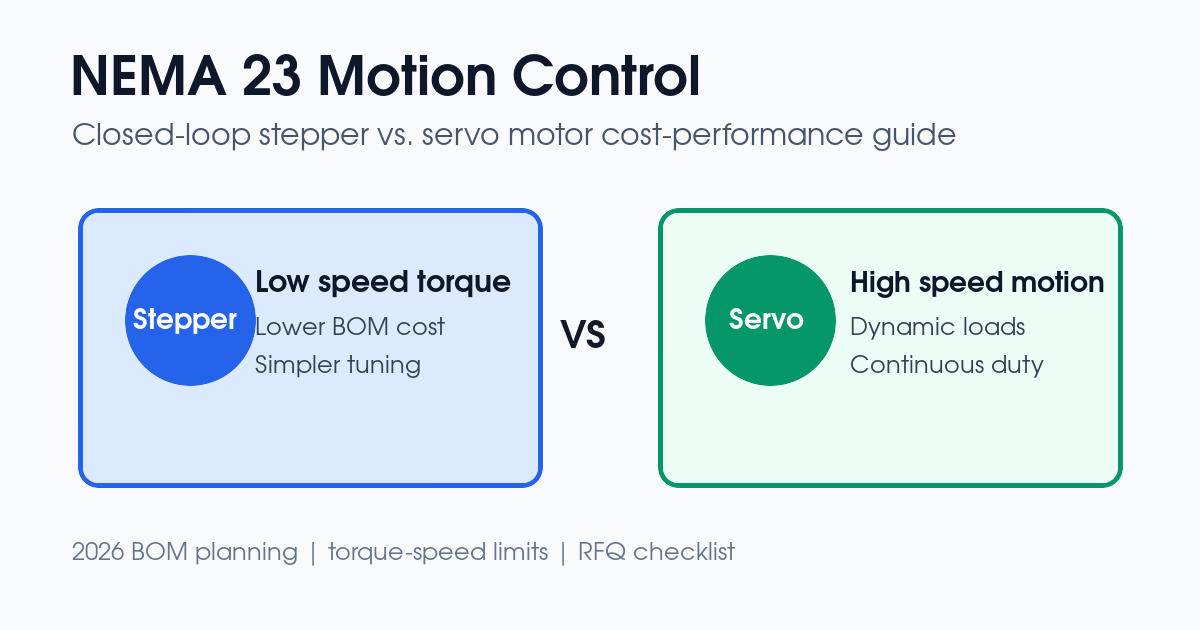
NEMA 23 Closed-Loop Steppers vs. Servo Motors: 2026 Cost-Performance Analysis
Compare NEMA 23 closed-loop steppers vs servo motors for 2026 BOM planning: costs, torque-speed limits, tuning effort, and RFQ checks before procurement.
For decades, the division in motion control was clear: use a stepper motor for low-cost, low-speed positioning, and upgrade to a servo motor when high speed, dynamic response, and absolute reliability were required. However, the rapid advancement and cost-reduction of NEMA 23 closed-loop stepper motors (also known as hybrid servos) have aggressively blurred this line in 2026.
By adding high-resolution encoders and closed-loop control algorithms to traditional steppers, manufacturers can now eliminate the dreaded "lost steps" without paying the premium of a full AC/DC servo system. For procurement teams and machinery builders, replacing a NEMA 23-class servo with a closed-loop stepper represents a significant opportunity to slash Bill of Materials (BOM) costs—but only if the engineering boundaries are strictly respected.
Last updated: 2026-07-19. Scope: Cost-performance evaluation, torque-speed profiling, and procurement qualification criteria.
Method note: This is a procurement planning comparison for NEMA 23-class axes, using published motion-control guidance plus common 2026 small-machine BOM screening bands. Treat the price ranges below as quote-screening ranges, not guaranteed market pricing; validate final torque-speed curves, duty cycle, supply voltage, encoder resolution, and certifications against supplier datasheets and sample-axis tests.
If you are already shortlisting parts for an RFQ, use the checklist in Section 3 before requesting a free application review.
1. The Core Comparison: Economics and Mechanics
When specifying motion control for equipment like CNC routers, 3D printers, labeling machines, or automated test equipment, the NEMA 23 frame size is the ubiquitous workhorse. Here is how closed-loop steppers stack up against true servos in this form factor.
Technical & Economic Comparison Table
| Specification / Feature | NEMA 23 Closed-Loop Stepper | NEMA 23-Class Servo Motor | Procurement Impact |
|---|---|---|---|
| System Cost (Motor + Drive) | Low to Moderate ($80 - $150 planning band) | High ($300 - $800+ planning band) | Closed-loop steppers can cut axis costs by 50-70% when speed and duty-cycle limits fit |
| Low-Speed Torque (0-500 RPM) | Excellent (High Holding Torque) | Moderate (Requires gearhead) | Steppers often eliminate the need for a gearbox |
| High-Speed Torque (>1000 RPM) | Poor (Rapid torque drop-off) | Excellent (Flat torque curve) | Servos are mandatory for high-speed continuous motion |
| Tuning & Commissioning | Near Plug-and-Play (Auto-tuning) | Complex (PID loop tuning required) | Steppers reduce engineering setup and assembly time |
| Position Hunting (Dithering) | None (Absolute standstill) | Yes (Constantly hunts +/- 1 count) | Steppers provide superior stability for vision inspection |
| Power Consumption / Heat | Moderate (Runs hotter, variable draw) | Highly Efficient (Current proportional to load) | Servos extend life in heavy, continuous duty cycles |
2. Engineering Boundary: The Speed vs. Torque Curve
The most critical engineering limitation of any stepper motor—even closed-loop—is the physical degradation of torque as speed increases.
Unlike a servo motor that maintains a relatively flat torque curve up to its rated speed (often 3,000+ RPM), a NEMA 23 closed-loop stepper provides massive holding torque at 0 RPM but quickly loses power after 600-800 RPM due to back-EMF and inductance.
Closed-Loop Architecture Visualization
How Closed-Loop Feedback Prevents Lost Steps
The encoder verifies position. If external forces cause a missed step, the drive injects additional current to catch up instantly, providing servo-like reliability.
3. Procurement & Engineering Qualification Checklist
If you are considering swapping out a NEMA 23 servo for a closed-loop stepper to save costs, run your application through this validation checklist. If you answer "Yes" to the failure conditions, you must stick with a servo.
- Speed Requirement: Does the axis need to operate above 1,000 RPM continuously? (If Yes ➔ Use Servo)
- Load Fluctuation: Is the load highly dynamic and changing instantly (e.g., a flying shear)? (If Yes ➔ Use Servo)
- Holding Torque: Does the application require the motor to hold a heavy vertical load perfectly still without micro-vibrations? (If Yes ➔ Use Closed-Loop Stepper)
- Tuning Capacity: Does your assembly team lack the time or skill to tune complex PID loops for every machine? (If Yes ➔ Use Closed-Loop Stepper)
- Gearbox Elimination: Can you utilize the massive low-speed torque of a stepper to direct-drive the load, eliminating a $100 planetary gearbox? (If Yes ➔ Use Closed-Loop Stepper)
4. Frequently Asked Questions (FAQ)
Q: Do closed-loop steppers run as hot as open-loop steppers? A: No. Traditional open-loop steppers draw maximum current at all times, generating immense heat. Closed-loop steppers dynamically adjust the phase current based on the actual load, running significantly cooler and extending bearing life.
Q: Can a NEMA 23 closed-loop stepper recover from a physical jam? A: Yes, up to a point. If the motor is stalled by a physical obstruction, the encoder registers the error. Once the obstruction is cleared, the drive will attempt to drive the motor back to the commanded position. However, if the error exceeds a programmed threshold, the drive will issue a fault alarm to the PLC, just like a servo.
Q: Are they a drop-in mechanical replacement for a NEMA 23 servo? A: Mechanically, yes. The NEMA 23 bolt pattern (56.4mm x 56.4mm faceplate, 47.14mm hole spacing) is standard. However, you must verify the motor length (which is often longer due to the encoder) and ensure your power supply voltage (typically 24V-48V DC) matches the drive requirements.
5. Next Steps for Implementation
The transition from expensive servos to cost-effective closed-loop steppers is a proven path to higher margins for OEMs. However, verifying the torque drop-off against your machine's motion profile is crucial.
Ready to validate your design? Review our detailed NEMA 23 stepper dimensions and specs to check mechanical clearance, or explore compatible NEMA 23 stepper drivers designed for closed-loop feedback. If you have an active RFQ and need a second set of eyes on a torque curve, contact our engineering team for a free application review.
References
Next step for your project
Share torque, speed, driver requirements and planned volume for an OEM inquiry review.