NEMA 23 Integrated Stepper Motors: 2026 Sourcing & Engineering Guide
A 2026 sourcing guide for NEMA 23 integrated stepper motors: compare protocol choices, TCO, thermal limits, EMC checks, RFQ data, and supplier trade-offs.
As automation systems grow more complex and cabinet space becomes increasingly expensive, the traditional architecture of centralized motion control is rapidly being replaced by decentralized systems. At the forefront of this shift is the NEMA 23 Integrated Stepper Motor. By combining a high-torque stepper motor, a high-resolution encoder, and an intelligent digital drive into a single, compact unit, manufacturers are redefining how machines are designed, wired, and maintained.
For procurement teams, mechanical engineers, and system integrators operating in 2026, sourcing an integrated NEMA 23 motor is no longer a simple catalog selection. It represents a strategic shift in the Bill of Materials (BOM). While a standalone NEMA 23 motor might be evaluated purely on holding torque and phase current, an integrated unit must be evaluated on its communication protocol stack, thermal dissipation capabilities, vibration tolerance, and overall Total Cost of Ownership (TCO).
This guide is designed to provide actionable, deep-dive insights into the procurement, specification, and application of integrated NEMA 23 stepper motors. Whether you are automating a new multi-axis CNC machine, designing a fleet of Autonomous Mobile Robots (AMRs), or upgrading a packaging line, this comprehensive resource will help you navigate the complexities of decentralized motion control.
Last updated: 2026-07-18. Scope: Global procurement standards, engineering trade-offs, and compliance for NEMA 23 integrated stepper units. Evidence boundary: Percent savings and protocol premiums below are RFQ-screening ranges, not guaranteed outcomes; validate them against supplier quotes, thermal-soak tests, EMC reports, and your actual machine duty cycle before purchase order release.
Fast path for active RFQs: Confirm the NEMA 23 stepper motor selection basics, verify NEMA 23 dimensions, match the NEMA 23 stepper driver and current limits, then contact our engineering team if you need a supplier quote package reviewed before sampling.
1. The Shift to Decentralized Motion Control
Historically, a standard automation panel featured a PLC or motion controller wired to multiple stepper drives inside a large electrical cabinet. Thick motor cables, carrying high-current PWM signals, would run from the cabinet to the standalone NEMA 23 motors mounted on the machine axes.
In 2026, the decentralized architecture flips this model. The drive electronics are miniaturized and mounted directly to the rear of the NEMA 23 motor.
Why the Market is Transitioning
- Cabinet Space Reduction: Moving the drive out of the central control cabinet can reduce cabinet size requirements by up to 40%. In space-constrained applications like AGVs (Automated Guided Vehicles) and medical robotics, this is not just a cost-saving measure; it is a fundamental design requirement.
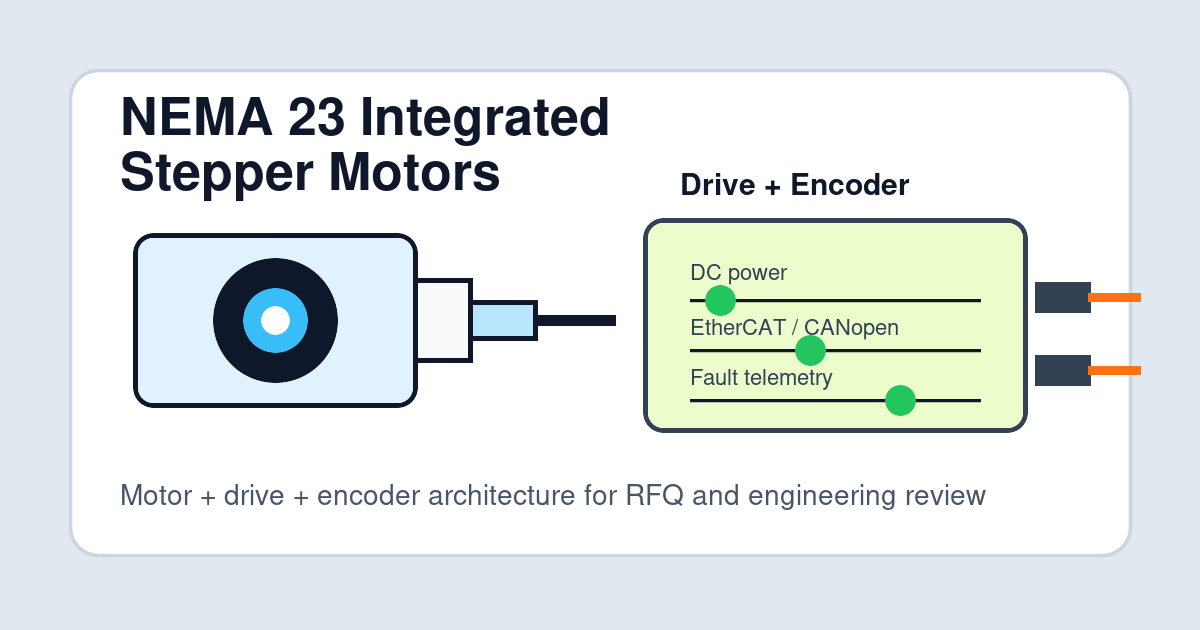
- Wiring Cost and EMI Reduction: Long runs of motor cables act as antennas, broadcasting Electromagnetic Interference (EMI) that can corrupt sensitive sensor data. Integrated motors require only DC power and a communication bus (such as EtherCAT or CANopen) to be routed through the machine. This dramatically reduces cable bulk, shielding costs, and assembly labor.
- Plug-and-Play Maintenance: When an axis fails, maintenance teams no longer have to diagnose whether the fault lies in the drive, the motor, or the cable between them. The entire integrated unit is replaced via quick-disconnect M12 connectors, minimizing costly machine downtime.
2. Engineering Trade-Offs: When NOT to Use Integrated Motors
While the benefits are compelling, integrated NEMA 23 motors are not a universal panacea. Combining a heat-generating motor with heat-sensitive silicon electronics introduces critical physical boundaries. Procurement and engineering teams must align on these limitations before committing to a decentralized architecture.
Thermal Boundaries
A standard NEMA 23 stepper motor can safely operate with internal case temperatures approaching 80°C to 90°C. However, the integrated drive PCB contains microcontrollers, MOSFETs, and electrolytic capacitors that degrade rapidly above 75°C.
- The Rule of Thumb: If the ambient temperature of the operating environment consistently exceeds 50°C (e.g., near industrial ovens or unventilated enclosures), an integrated motor will likely suffer premature electronic failure. In these scenarios, a traditional split architecture (motor in the hot zone, drive in a cooled cabinet) is mandatory.
Shock and Vibration Limits
Mounting the drive directly to the motor means the PCB is subjected to the same mechanical shocks as the machine axis.
- High-vibration environments, such as heavy milling machines or stamping presses, can cause solder joint fatigue on the integrated drive board. Always verify the supplier's vibration rating (e.g., MIL-STD-810G or specific g-force ratings at specific frequencies) before sourcing.
3. Communication Protocols: The True Differentiator
In 2026, the mechanical specifications of NEMA 23 integrated motors are largely commoditized. The true differentiator—and the primary driver of cost—is the integrated communication protocol. Choosing the right protocol dictates the responsiveness of your machine and locks you into a specific software ecosystem.
The Protocol Landscape
- Pulse/Direction (Step/Dir): The legacy standard. Very low cost, but offers no telemetry. You cannot read back the motor's temperature, position, or fault status. Not recommended for modern Industry 4.0 applications.
- RS-485 (Modbus RTU): Excellent for low-speed monitoring and point-to-point positioning. Extremely cost-effective but lacks the determinism required for high-speed, multi-axis interpolated movement.
- CANopen: The mid-tier workhorse. Highly reliable in noisy environments, supports the CiA 402 motion control profile, and is ideal for mobile robotics and AGVs.
- EtherCAT: The gold standard for 2026. Provides microsecond-level synchronization across dozens of axes. Essential for high-end CNC equipment, packaging machines, and applications requiring real-time closed-loop control. Procurement should expect a 20-40% premium for EtherCAT-enabled integrated motors.
4. TCO Analysis: Integrated vs. Distributed Systems
When presenting a business case to finance, procurement managers must move beyond piece-price comparison. An integrated NEMA 23 motor will almost always cost more upfront than a standalone NEMA 23 motor. The savings are realized in the surrounding ecosystem.
Comprehensive Cost Comparison Matrix
| Cost Factor | Traditional Distributed System (Separate Motor + Drive) | Integrated NEMA 23 System (Motor + Drive Combo) | Procurement Impact / Notes |
|---|---|---|---|
| Component BOM Cost | Lower (Commodity pricing for separate parts) | Higher (Premium for miniaturized electronics) | Base hardware cost increases by 15-30% for integrated. |
| Cabinet Enclosure Cost | High (Requires large, cooled NEMA cabinets) | Low (Cabinet can be downsized or eliminated) | Substantial savings in sheet metal and factory floor space. |
| Cabling & Shielding | High (Long, thick, shielded motor cables needed) | Low (Only DC power and standard Cat5e/CAN bus) | Cabling costs can drop by over 50%. |
| Assembly Labor | High (Complex cabinet wiring, crimping, routing) | Low (Daisy-chained M12 plug-and-play connectors) | Speeds up machine build time significantly. |
| Inventory Management | Complex (Manage SKUs for motors, drives, cables) | Simplified (One unified part number to track) | Reduces warehouse overhead and purchasing administration. |
| Maintenance & Downtime | Moderate (Requires diagnostic skills to isolate fault) | Low (Swap the entire unit in minutes) | Massive TCO advantage for end-users relying on uptime. |
| Replacement Cost | Low (Only replace the failed sub-component) | High (Must replace functional parts if one fails) | The main drawback; a blown drive means throwing away a good motor. |
| Thermal Management | Easy (Heat sources are physically separated) | Difficult (Electronics are bolted to a hot motor) | Requires strict adherence to ambient temperature limits. |
Table 1: A multi-dimensional view of the Total Cost of Ownership between decentralized and centralized motion control architectures.
5. Supplier Selection and Verification Checklist
Do not rely solely on a glossy datasheet when sourcing integrated motors. The integration of power electronics and magnetics requires sophisticated manufacturing capabilities. Use this checklist to audit potential suppliers:
Sourcing & Engineering Checklist
- Thermal Derating Curves: Did the supplier provide a continuous torque curve that accounts for internal PCB temperature limits, or just a peak theoretical torque curve?
- Connector IP Rating: Are the communication and power connectors standard M12 industrial connectors rated to IP65/IP67, or are they fragile consumer-grade headers?
- EMI/EMC Certification: Does the integrated unit carry valid CE Marking (EN 61800-3 for variable speed drives)? A poorly shielded integrated motor will crash the communication bus.
- Encoder Resolution Verification: For closed-loop models, is the magnetic or optical encoder truly high-resolution (e.g., 14-bit or 16-bit), or is the internal firmware artificially interpolating a low-resolution signal?
- Firmware Update Mechanism: Can the integrated drive's firmware be updated over the communication bus (e.g., FoE for EtherCAT), or does it require a proprietary serial cable and factory return?
- Supply Chain Transparency: Are the core microcontrollers (MCUs) dual-sourced, or is the supplier vulnerable to single-chip allocation shortages?
6. Frequently Asked Questions (FAQ)
Q: Can an integrated NEMA 23 stepper motor run continuously at 100% duty cycle?
A: It depends heavily on the ambient temperature and the mounting surface. If mounted to a thick aluminum machine frame (which acts as a heatsink) in a 25°C environment, yes. In a confined, unventilated space, the integrated drive's thermal protection will likely trigger and shut down the motor to prevent PCB damage.
Q: Do integrated stepper motors require homing sensors?
A: Standard incremental integrated motors still require homing at startup. However, in 2026, many suppliers offer integrated NEMA 23 units with battery-free multi-turn absolute encoders. These eliminate the need for external limit switches and homing routines, allowing immediate machine operation after a power cycle.
Q: Is it possible to customize the shaft of an integrated motor?
A: Yes, the mechanical motor housing is identical to a standard NEMA 23. Custom shaft lengths, D-flats, keyways, and even custom windings are routinely provided by major manufacturers, provided your MOQ (Minimum Order Quantity) supports the tooling costs.
Q: What happens if the drive firmware crashes?
A: Industrial-grade integrated motors include hardware watchdog timers. If the firmware hangs, the watchdog forces a safe shutdown of the power stage to prevent uncontrolled axis movement. Always ensure this safety feature is documented in the supplier's functional safety manual.
Q: How do integrated NEMA 23 motors compare to integrated AC Servos?
A: Integrated NEMA 23 steppers excel in high-torque, low-speed applications (0 - 1000 RPM) without the need for complex tuning. Integrated AC servos are more expensive but dominate in high-speed applications (3000+ RPM) where dynamic acceleration is required.
7. Next Steps for Your Project
Transitioning to a decentralized motion control architecture using integrated NEMA 23 stepper motors can radically streamline your machine design, lower your Bill of Materials complexity, and provide your customers with a more reliable, IoT-ready product. However, the success of this transition relies entirely on rigorous thermal validation and selecting a supplier with proven EMC compliance and robust firmware.
Before finalizing your schematics or issuing a bulk RFQ, it is critical to validate the motor's performance in your specific mechanical assembly.
Ready to evaluate an integrated solution?
- Review our detailed NEMA 23 Dimensions Guide to ensure mechanical compatibility with your current mounts.
- Prepare your load inertia calculations, ambient temperature profiles, and preferred communication bus (e.g., EtherCAT or CANopen).
- Contact our engineering and procurement support team to request evaluation units, custom shaft drawings, or a comprehensive landed-cost quote tailored to your production schedule.
References & Sources
- EtherCAT Technology Group (ETG). EtherCAT Device Protocol Specifications. https://www.ethercat.org/en/technology.html
- European Commission. Machinery Directive / Single Market Economy. https://single-market-economy.ec.europa.eu/sectors/mechanical-engineering/machinery_en
- IEEE Xplore. IEEE Industrial Electronics Magazine publication page. https://ieeexplore.ieee.org/xpl/RecentIssue.jsp?punumber=4154445
Next step for your project
Share torque, speed, driver requirements and planned volume for an OEM inquiry review.