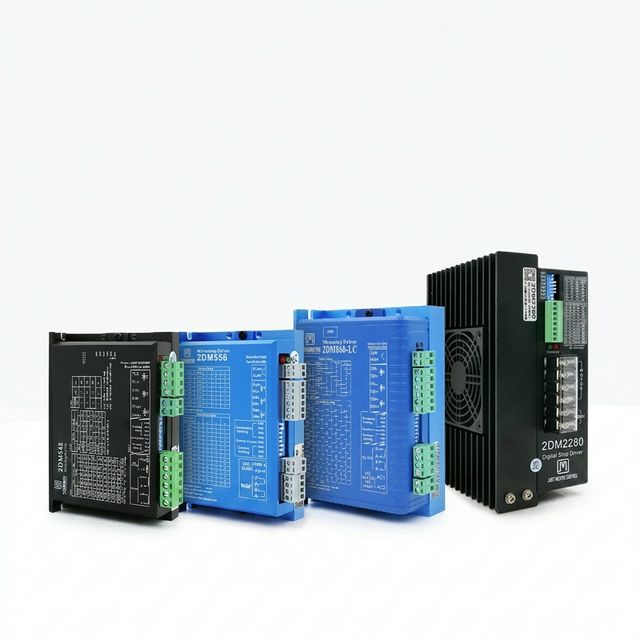
Driver Current and Voltage Mistakes on NEMA 23 Projects
Most field failures are not motor defects. They are current-setting, pulse-interface, and thermal-validation mistakes.
1) Running far below rated current
Teams sometimes derate current too aggressively to stay cool, then wonder why dynamic torque collapses under acceleration.
If configured current is much lower than nameplate, treat missed-step risk as predictable, not random.
2) Raising bus voltage without strict current limit
Higher voltage can improve current slew at speed, but only if current limiting is configured and verified. Otherwise winding temperature rises fast.
Always pair voltage changes with soak testing at worst-case duty cycle before production release.
3) Ignoring signal integrity on pulse lines
At higher pulse rates, edge quality and cable routing become part of motor reliability. Noise and jitter can trigger intermittent step loss.
Validate STEP/DIR waveform at peak command rate and long-cable layout, not only on a short bench setup.
4) Use risk bands for current setting decisions
Working guidance for early commissioning: around 90% to 100% of nameplate is typically the practical range. Below about 75% can create frequent under-torque risk under dynamic load.
Above about 110% should be treated as thermal-risk mode. Only allow it with explicit soak-test evidence and clear duty-cycle limits.
Do not approve production settings based only on driver dial labels. Validate actual phase current on the real hardware stack.
5) Commissioning test scope that catches real failures
Minimum scope should include three conditions: low-speed contouring, peak RPM operation, and repeated accel-decel transitions. Step loss often appears only in transitions.
Capture evidence with current waveform snapshot, STEP/DIR waveform quality, motor temperature trend, and final pass/fail summary per condition.
If cable length changes from lab to machine, repeat pulse integrity checks. A bench pass does not guarantee field pass.
6) Escalation rule: when to move to closed-loop
Move to closed-loop when missed-step consequence is high, dynamic load changes are frequent, or open-loop tuning time keeps delaying launch.
Use a simple manager rule: if your team cannot keep pulse margin and thermal margin simultaneously under production duty, the closed-loop option usually has lower total project risk.
Driver Deep Dive: From Symptom to Root Cause
This section turns current and voltage theory into a practical debug sequence your commissioning team can execute on site.
Current ratio
current_ratio = configured_phase_current / nameplate_phase_current
Use this ratio first when missed steps appear under acceleration.
Thermal margin
thermal_margin_degC = winding_limit_degC - measured_winding_degC
Treat margins below 10 degC as red-zone for production duty.
Pulse margin
pulse_margin = (controller_limit_hz - required_hz) / controller_limit_hz
Keep margin above 15% to reduce random field resets.
Current-ratio risk bands
Most under-torque and overheating cases can be triaged quickly by this one ratio.
Field debug flow for unstable motion
Use this order to avoid endless setting tweaks without evidence.
Symptom to root-cause isolation table
Map each symptom to one measurable test before changing multiple settings at once.
| Observed symptom | Most likely cause | Fast measurement | Corrective action |
|---|---|---|---|
| Missed steps at accel transitions | Current ratio too low or ramp too steep | Check current ratio + accel profile log | Raise current within safe zone, retune ramp |
| Hot motor housing after 20-30 min | Over-current or poor thermal path | 2-hour soak trend at worst duty | Lower current or add cooling and verify |
| Random jitter at high speed only | STEP/DIR edge quality degradation | Scope waveform at machine cable length | Improve routing or use differential signaling |
Commissioning test log template
Use the same template across pilot and MP to keep evidence comparable.
| Test condition | Command profile | Measured result | Pass rule |
|---|---|---|---|
| Low-speed contouring | 120 RPM, 300 cycles | No step loss, stable current ripple | All cycles pass |
| Peak speed hold | 850 RPM for 15 min | No alarm, no vibration burst | No unstable segment > 2 sec |
| Accel-decel stress test | 0-850-0 RPM x 500 cycles | 0 missed steps, stable case temp trend | No drift against baseline |
Buyer Resources
Download editable templates and review external references to validate selection and OEM decisions.
Ready-to-use downloads
Download driver audit checklist (CSV)
Commissioning checklist for current, pulse margin, and thermal validation evidence.
Download driver review template (TXT)
Inquiry draft for factory-side root-cause review of missed steps or overheating.
Citable references
DRV8825 Stepper Motor Controller Datasheet
Source: Texas Instruments
Primary reference for current regulation and protection behavior.
Open referenceApplication Report SLVA959
Source: Texas Instruments
Use for deeper driver-current interpretation during tuning and debugging.
Open referenceA4988 DMOS Microstepping Driver Datasheet
Source: Pololu
Cross-check reference when teams compare different driver families.
Open referenceStepper Motor Technology Basics
Source: Oriental Motor
Useful for understanding torque-speed and resonance factors in field behavior.
Open referenceDriver setup audit table
Fill this before inquiry to isolate under-torque and overheating root causes quickly.
| Field | Example input | Why it matters |
|---|---|---|
| Motor nameplate phase current | 3.0 A/phase | Defines safe baseline for driver current setting. |
| Configured phase current | 2.8 A RMS configured | Separates under-current torque loss from other issues. |
| Bus voltage and PSU margin | 48 V bus, 30% PSU headroom at peak load | Prevents voltage sag and unstable high-speed torque. |
| Max pulse command rate | Expected 160 kHz, controller limit 200 kHz | Checks pulse margin before field vibration appears. |
| STEP/DIR signal and cable routing | 24 V differential, 3.5 m cable separated from power lines | Reduces jitter/noise induced intermittent step loss. |
| Thermal soak acceptance criteria | 2-hour soak, winding <=85 degC, case <=70 degC | Prevents releasing unstable settings to production. |
| No-step-loss transition test | 500 accel/decel cycles with zero missed steps | Transition zones are where most hidden failures appear. |
| Closed-loop escalation trigger | Escalate if pulse margin <15% and thermal margin <10 degC | Creates a clear rule before launch pressure increases. |
Copyable driver-matching inquiry template
Share your current settings and get a quick risk review from the factory team.
Subject
NEMA 23 Driver Matching Review - [Project Line]
Body
Hello Nema23Motor engineering team,

Please review our motor-driver setup for stability and thermal risk:
- Motor part number + nameplate phase current [value].
- Driver model + configured phase current [value].
- Bus voltage [value], PSU rating [value], cable length [value].
- Pulse command: STEP frequency max [kHz], microstep [value].
- Duty cycle: [profile], ambient [degC], measured winding temp [degC].
- Observed issue: [missed steps / heat / vibration], when it happens.

Please advise corrective settings and whether closed-loop is recommended.
Buyer FAQs
Why does under-current setting often look like random missed steps?
Because dynamic torque collapses first during acceleration and transitions. The issue appears random in production logs, but root cause is often configured current below practical range.
Does higher bus voltage always improve NEMA 23 performance?
Not by itself. Higher voltage must be paired with verified current limiting and thermal soak validation, otherwise overheating risk increases quickly.
When should a team escalate to closed-loop control?
Escalate when open-loop tuning cannot keep pulse margin and thermal margin simultaneously under production duty, or when missed-step consequence is too costly.
Related articles
NEMA 23 Market Update (2026-W19): U.S. Tariff Corrections Shift Landed-Cost Math Before the EU Machinery Gate
One-line decision: do not release U.S.-bound NEMA 23 POs in 2026-W19 unless landed-cost sheets include post-2026-04-06 tariff assumptions, FR 2026-08297 correction checks, and a dated EU compliance owner.
NEMA 23 Selection Checklist for CNC Builders
If your team is choosing between multiple NEMA 23 models, this checklist helps you avoid the most common pre-PO mistakes.
Next step for your project
If you want a concrete recommendation for your axis, share target torque, RPM, current class, and planned volume.