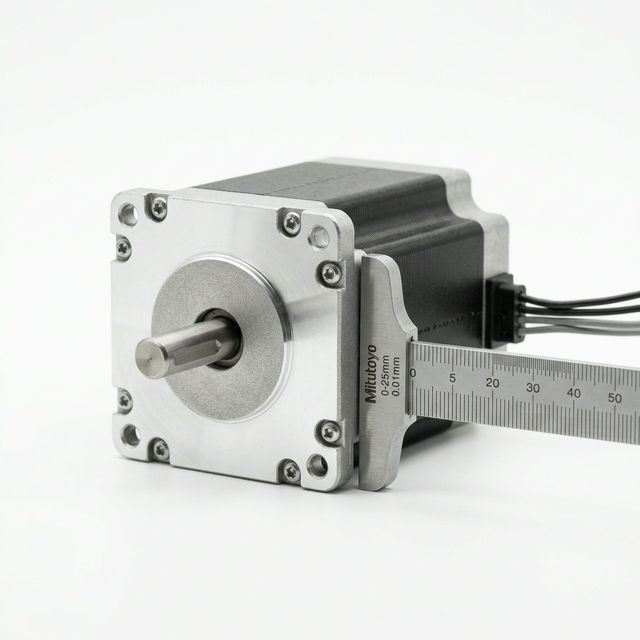
NEMA 23 Selection Checklist for CNC Builders
If your team is choosing between multiple NEMA 23 models, this checklist helps you avoid the most common pre-PO mistakes.
1) Define the real duty point, not only holding torque
Many projects fail because teams compare only catalog holding torque. For production sizing, the real decision variable is running torque at target RPM, acceleration profile, and reflected load inertia.
Before quotation freeze, request speed-torque curves under the same bus voltage and current limit that your machine will run.
2) Check pulse budget early
Fine step angle and microstepping can quickly consume controller pulse bandwidth. Use a simple rule: pulse Hz = steps per rev x microstep x RPM / 60.
Treat demand above about 85% of interface limit as a launch risk, especially with long cable runs and weak EMI control.
3) Lock current class and thermal window
The same NEMA 23 frame does not mean the same phase current. Confirm whether the selected driver can safely support the target current class with real thermal path.
Require a short thermal soak validation plan before mass order: ambient condition, load duty, and allowable winding temperature.
4) Use quick gating thresholds before PO
Use these screening boundaries for first-pass selection: pulse utilization below about 65% is comfortable, 65% to 85% needs careful validation, and above 85% is high integration risk.
For current setting, keep configured phase current close to nameplate. Around 90% to 100% is usually a practical commissioning band. Below 75% often causes under-torque risk, while above 110% is a thermal-risk zone without extra validation.
For load behavior, treat inertia ratio around 30:1 as a screening boundary from vendor guidance, not a universal law. Ratios above this need machine-level ramp and anti-stall validation.
5) RFQ package fields that prevent sample loops
Send a single-page RFQ sheet including: target torque/RPM duty point, acceleration profile, reflected load inertia estimate, desired step angle, preferred driver class, and controller pulse ceiling.
Add mechanical and integration constraints: shaft drawing tolerance, cable length, connector family, ambient temperature range, expected annual quantity, and required compliance markings.
Define acceptance criteria before sampling: max winding temperature, no-step-loss test profile, and waveform quality requirements at target pulse rate.
6) Final PO release checklist
Confirm the final motor-driver pair by part number, not by frame size name. NEMA 23 frame alone is not enough to guarantee current or torque class.
Confirm document set: speed-torque curve, wiring definition, test report under agreed conditions, and approved drawing revision.
Lock change control: any winding, connector, insulation class, or shaft process change must be notified before shipment.
Engineering Deep Dive: Selection Math and Release Gates
Use these formulas, visual checks, and gate tables to convert an early NEMA 23 shortlist into a production-ready PO package.
Pulse demand
pulse_hz = steps_per_rev x microstep x rpm / 60
Calculate this with worst-case RPM, not nominal RPM.
Pulse utilization
utilization = required_pulse_hz / controller_limit_hz
Treat values above 0.85 as high integration risk.
Dynamic torque margin
torque_margin = available_torque_at_speed / required_torque
Keep margin above 1.2x before pilot sign-off.
Microstep vs pulse utilization map
At fixed speed targets, aggressive microstep choices can consume interface budget quickly.
Pre-PO release gate flow
Move to purchase release only when all three technical gates pass with traceable evidence.
Scenario comparison table for controller strategy
Compare these bands before deciding default commissioning settings for pilot and MP.
| Scenario | Microstep + RPM target | Pulse utilization | Torque margin | Typical decision |
|---|---|---|---|---|
| Conservative pilot | 8x at 450 RPM | 31% | 1.45x | Use for first machine bring-up and baseline logs. |
| Balanced production | 16x at 650 RPM | 49% | 1.28x | Default for stable cycle time with thermal headroom. |
| Aggressive speed push | 64x at 850 RPM | 89% | 1.08x | Only with waveform capture and thermal proof. |
Pre-PO validation gate checklist
Assign owners and pass thresholds to avoid subjective approvals.
| Gate item | Verification method | Pass threshold | Evidence owner |
|---|---|---|---|
| Running torque at target RPM | Bench dyno + machine-side trend check | >=1.2x torque margin | Motion engineer |
| Pulse interface quality | Scope capture at max cable length | <85% utilization and clean edges | Controls engineer |
| Thermal soak | 2-hour worst-duty soak test | Stable temp trend and no alarms | Reliability engineer |
| Pilot consistency | 30-unit pilot audit | No critical deviation vs sample | SQE + purchasing |
Buyer Resources
Download editable templates and review external references to validate selection and OEM decisions.
Ready-to-use downloads
Download buyer checklist (CSV)
One-line-per-gate procurement checklist for pre-PO review.
Download RFQ template (TXT)
Copy-ready inquiry draft with required technical and commercial fields.
Citable references
DRV8825 Stepper Motor Controller Datasheet
Source: Texas Instruments
Reference for current limiting behavior and thermal constraints in driver setup.
Open referenceA4988 DMOS Microstepping Driver Datasheet
Source: Pololu
Useful baseline for microstepping behavior and current-set interpretation.
Open referenceStepper Motor Technology Basics
Source: Oriental Motor
Practical explanation of torque-speed behavior and application constraints.
Open referenceStepper Motor (theory overview)
Source: Wikipedia
Public reference for terminology alignment across cross-functional teams.
Open referenceParameter table before sending inquiry
Buyers who send these values usually receive a usable quote in fewer rounds.
| Field | Example input | Why it matters |
|---|---|---|
| Running torque at target RPM | 1.2 N.m at 450 RPM continuous | Prevents selection based only on static holding torque. |
| Peak speed and accel profile | 0 to 450 RPM in 180 ms, 80 cycles/min | Captures dynamic torque and missed-step risk. |
| Reflected load inertia | Estimated inertia ratio 18:1 | Defines usable ramp limits and anti-stall margin. |
| Driver current setting target | 3.0 A RMS target, 10% trim window | Aligns torque output with thermal headroom. |
| Pulse interface budget | Controller max 180 kHz, expected 120 kHz | Screens integration stability before wiring build. |
| Mechanical interface constraints | Shaft 8 mm D-cut, runout <=0.03 mm | Avoids redesign due to shaft or connector mismatch. |
| Thermal environment | Ambient 40 degC, enclosure with limited airflow | Sets realistic winding temperature acceptance limits. |
| Annual quantity and launch date | 12,000 units/year, SOP Sept 2026 | Guides MOQ, capacity booking, and lead-time plan. |
Copyable RFQ email template
Copy this draft, fill bracket fields, and send to [email protected].
Subject
NEMA 23 RFQ - [Machine/Axis] - [Annual Qty]
Body
Hello Nema23Motor team,

We need a quotation for a NEMA 23 motor solution for [machine/axis].
- Duty point: [required running torque] at [target RPM].
- Motion profile: [accel/decel time], reflected inertia [value].
- Driver/control: [driver model], max STEP pulse [kHz], bus voltage [V].
- Mechanical: shaft drawing [rev], cable length [m], connector [type].
- Validation: no-step-loss test [profile], max winding temp [degC].
- Commercial: annual qty [units], pilot date [date], Incoterm [term].

Please advise recommended part number, MOQ, and lead time.
Buyer FAQs
How much pulse margin is generally safe before launch?
For first-pass screening, below about 65% interface usage is usually comfortable. Between 65% and 85% needs stronger validation, and above 85% should be treated as high integration risk.
Should buyers size only by holding torque in the catalog?
No. B2B sizing should start from running torque at target RPM plus acceleration profile and reflected inertia. Holding torque alone does not describe production behavior.
What minimum data should be in the first RFQ email?
Include duty torque and RPM, accel profile, current class, pulse ceiling, shaft and connector constraints, thermal acceptance criteria, and annual quantity plan.
Related articles
NEMA 23 Market Update (2026-W19): U.S. Tariff Corrections Shift Landed-Cost Math Before the EU Machinery Gate
One-line decision: do not release U.S.-bound NEMA 23 POs in 2026-W19 unless landed-cost sheets include post-2026-04-06 tariff assumptions, FR 2026-08297 correction checks, and a dated EU compliance owner.
Driver Current and Voltage Mistakes on NEMA 23 Projects
Most field failures are not motor defects. They are current-setting, pulse-interface, and thermal-validation mistakes.
Next step for your project
If you want a concrete recommendation for your axis, share target torque, RPM, current class, and planned volume.